









Roughly 93% of American high school students take at least one physics course yet surveys consistently show that fewer than half feel confident explaining why a ball falls back down after you throw it. That gap between exposure and genuine understanding is exactly where physics fundamentals get lost.
Physics is not a collection of formulas to memorize. It is a framework for thinking one that explains everything from why bridges don’t collapse under rush-hour traffic to how your GPS app knows you missed your turn. Once you understand the core principles, the rest of the subject starts to feel like common sense rather than magic.
This guide is written for US students, self-learners and curious adults who want a clear, jargon-free entry point into the basic physics concepts that show up everywhere. By the end, you will understand the laws of physics that govern motion, energy and forces with real examples, honest explanations andpractical takeaways you can actually use. For more science and technology guides written for curious minds, visit Maple Star Magazine.
What Are Physics Fundamentals and Why Do They Matter?
Physics is the branch of natural science concerned with understanding how the universe behaves at its most basic level. The physics fundamentals are the foundational principles the bedrock laws and theories that every other branch of science and engineering builds on.
To put it plainly: chemistry borrows from physics to explain atomic bonds. Engineering uses physics to design every structure you trust with your life. Even biology, increasingly, leans on physics to explain how proteins fold and how nerves fire.
A Brief History of How We Got Here
The story of physics fundamentals in the modern sense begins in the 17th century, when Isaac Newton published his laws of motion and universal gravitation. Before Newton, the motion of a thrown rock and the orbit of a planet were considered completely unrelated phenomena. He showed they followed the same rules.
Over the next two centuries, scientists like James Clerk Maxwell added the laws governing electricity and magnetism. Then, in the early 1900s, Albert Einstein and Max Planck overturned the classical picture entirely Einstein with relativity (the behavior of objects moving near the speed of light) and Planck with quantum theory (the behavior of matter at the atomic scale).
Today, intro to physics in the US typically covers classical mechanics, thermodynamics, waves, electricity and magnetism. Quantum and relativistic physics come later but they rest entirely on the classical foundation you build first.
Why the US Educational Focus Matters
The College Board’s AP Physics 1 and Physics 2 courses are taken by over 250,000 US students annually. According to the American Institute of Physics, physics bachelor’s degrees in the US have increased by more than 25% over the past decade. The subject is not a niche academic exercise it is a direct gateway to careers in engineering, medicine, data science and emerging tech fields like quantum computing and aerospace.
Understanding physics fundamentals is not just about passing exams. The analytical thinking it builds breaking complex problems into measurable parts, testing assumptions, identifying cause and effect transfers directly to professional life in almost every field.
The Core Laws of Physics Every Beginner Should Know
There are dozens of named laws in physics but the ones below form the engine that drives everything else. Think of them as the grammar rules of a language once you have them, you can construct almost any sentence.
Newton’s Three Laws of Motion
Sir Isaac Newton published these in 1687 and they remain the starting point for every intro to physics course worldwide.
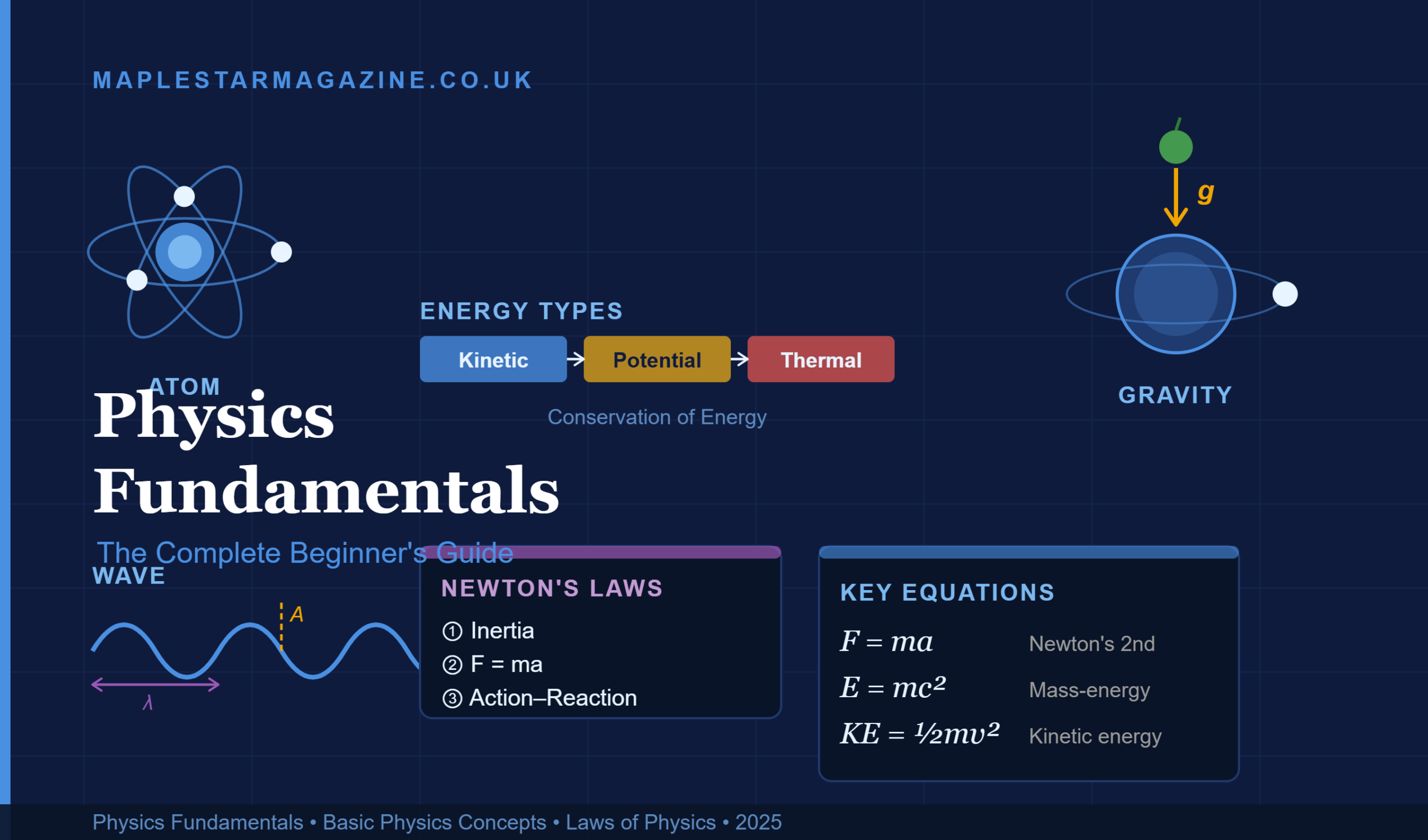
- First Law (Inertia): An object at rest stays at rest and an object in motion stays in motion, unless acted on by an outside force. This is why you lurch forward when a car brakes suddenly your body was in motion and wanted to stay that way.
- Second Law (F = ma): Force equals mass times acceleration. The heavier an object is or the faster you want it to accelerate, the more force you need. This is why it takes more effort to push a loaded shopping cart than an empty one.
- Third Law (Action-Reaction): For every action, there is an equal and opposite reaction. When you push off a wall, the wall pushes back on you with exactly the same force which is why you move and the wall doesn’t.
A practical case study: NASA engineers use Newton’s second and third laws constantly in rocket design. A rocket expels gas downward (action); the gas pushes the rocket upward (reaction). The rate of acceleration depends on the mass of the rocket and the force of the expelled gas pure F = ma.
The Law of Conservation of Energy
Energy cannot be created or destroyed. It can only change from one form to another. This principle, known as the first law of thermodynamics in heat-related contexts, is one of the most powerful ideas in all of science.
When you ride a roller coaster, the energy stored as height (potential energy) converts to speed (kinetic energy) as you descend. None of it disappears it either becomes motion, heat from friction or sound. The total always stays the same.
According to the US Energy Information Administration, understanding energy conversion is central to every renewable energy system the country is scaling up from wind turbines converting kinetic energy to electricity to solar panels converting light energy to electrical current.
Gravity, Electromagnetism and the Four Fundamental Forces
At the deepest level, physicists have identified four fundamental forces that account for every interaction in the universe:
| Force | What It Governs | Everyday Example |
| Gravity | Attraction between masses | Keeps you on the ground; orbits planets |
| Electromagnetism | Charged particles; light | Powers every electrical device you own |
| Strong Nuclear | Holds atomic nuclei together | What nuclear reactors and bombs release |
| Weak Nuclear | Radioactive decay | Carbon-14 dating; solar fusion |
Key Concepts in Basic Physics That Beginners Often Misunderstand
Mass vs. Weight: Not the Same Thing
This is one of the most common sources of confusion in intro to physics. Mass is the amount of matter in an object it does not change regardless of where you are. Weight is the force gravity exerts on that mass it changes depending on gravitational pull.
An astronaut who weighs 180 pounds on Earth weighs about 30 pounds on the Moon, because the Moon’s gravity is roughly one-sixth of Earth’s. But their mass the amount of matter in their body is identical in both places. The distinction matters enormously in aerospace engineering, satellite deployment and medicine.
Velocity vs. Speed: Direction Changes Everything
Speed is how fast something moves. Velocity is speed with a direction attached. A car moving at 60 mph is a speed. A car moving at 60 mph due north is a velocity.
Why does this matter? Because physics and engineering often cares not just about how fast something moves, but where it is going. A missile defense system tracking an incoming object needs both speed and direction to calculate an intercept point. So does an autonomous vehicle deciding when to brake.
Work, Power and Energy: Three Related but Distinct Ideas
In everyday speech, these words are interchangeable. In physics, they are not.
- Work is done when a force moves an object through a distance. Holding a heavy book above your head takes effort but if the book doesn’t move, you’ve done zero work in the physics sense.
- Energy is the capacity to do work stored as potential energy (height, chemical bonds, compressed springs) or released as kinetic energy (motion).
- Power is the rate at which work is done. Two people might lift the same box to the same height, doing identical work but the one who does it in half the time is using twice the power.
Analysis and Insights: Why Physics Fundamentals Are Harder to Learn Than They Should Be
Here is a counterintuitive observation that most physics teachers acknowledge privately: the biggest obstacle to learning basic physics concepts is not the math. It is unlearning intuition.
Human beings evolved to navigate a world of medium-sized objects moving at medium speeds. Our intuitions are finely tuned for that environment. Physics, however, describes reality at scales both tiny and enormous, both slow and near-light-speed where everyday intuition consistently fails.
Newton’s first law is a perfect example. Most people, if asked, believe objects naturally slow down and stop. That feels right based on every experience they’ve ever had. But it’s wrong objects stop because friction acts on them. In a frictionless environment, an object in motion would continue forever. The law is counterintuitive, not because it is complex but because our everyday experience hides the relevant variable (friction) in plain sight.
A 2022 study from the American Association of Physics Teachers found that students who spent time explicitly examining their pre-existing intuitions before formal instruction showed significantly better retention of physics concepts six months later, compared to students who received standard instruction. The lesson: confronting what you think you know is more valuable than memorizing what is correct.
The second pattern worth noting is the role of mathematics anxiety in the US physics classroom. A recurring finding in education research is that many students abandon physics not because they find the concepts too abstract but because algebra and trigonometry feel like a separate barrier on top of an already unfamiliar subject. The most effective physics instruction including successful online curricula from platforms like Khan Academy and MIT OpenCourseWare treats the math as a language to describe physical reality, not as a separate hurdle.
Practical Recommendations for Learning Physics Fundamentals in 2025
Whether you’re a high school student preparing for AP Physics, a college freshman, or an adult returning to STEM, these steps will give you the most direct path to genuine understanding.
- Start with conceptual understanding before touching equations. Read or watch an explanation of Newton’s laws, conservation of energy, or wave behavior using words and diagrams first. The equation should feel like a confirmation of something you already understand, not the starting point. Resources like Richard Feynman’s Feynman Lectures (freely available at feynmanlectures.caltech.edu) are unmatched for this approach.
- Use physical demonstrations, even simple ones. Drop two objects of different mass from the same height and watch them land simultaneously. Roll a ball across a smooth floor and observe how far it goes. Physics is an empirical science connecting principles to physical experience accelerates learning faster than any textbook.
- Work practice problems immediately after learning each concept. Do not read a chapter and move on. Work at least five problems before advancing. The American Physical Society recommends spaced repetition and active problem-solving over passive reading for building durable physics knowledge.
- Build a concept map, not just notes. After each major topic, draw a diagram showing how the concepts connect. How does Newton’s second law relate to conservation of momentum? How does kinetic energy connect to work? Seeing the structure of physics not just isolated facts is what separates students who retain knowledge from those who forget it after the exam.
- Use free US-accessible resources strategically. Khan Academy’s Physics section covers all of AP Physics 1 and 2 with video lessons, interactive exercises and full practice tests at no cost. MIT OpenCourseWare offers actual university lecture notes and problem sets. PhET Interactive Simulations (phet.colorado.edu), developed by the University of Colorado Boulder, lets you manipulate virtual physics scenarios in your browser.
- Find where physics fundamentals appear in your own life and career. If you are in nursing, learn how fluid dynamics explains blood pressure. If you are in construction, trace Newton’s laws through every load-bearing calculation. Physics is not abstract when you can see it operating in your daily work.
Physics Fundamentals Are a Thinking Tool, Not Just a Subject
The laws of physics do not exist in textbooks. They exist in the coffee cooling on your desk, the arc of a basketball, the design of the car that keeps you safe in a collision and the satellites that make your phone useful. Physics fundamentals are simply the language we use to describe what was already happening.
Learning this language is not about becoming a physicist. It is about gaining a framework for reasoning that makes you better at almost any technical or analytical problem you will ever face.
Key takeaways from this guide:
- Physics fundamentals Newton’s laws, conservation of energy, the four fundamental forces are the foundation beneath all science and engineering.
- Common misconceptions about mass vs. weight, speed vs. velocity and intuitive motion are the real barrier for most learners, not the mathematics.
- The US educational system provides strong pathways (AP Physics, MIT OCW, Khan Academy, PhET) to build genuine understanding without cost barriers.
- The most effective learning strategy combines conceptual grounding, physical demonstration, deliberate practice and connecting principles to real-world contexts.
Start with one concept. Understand it until it feels obvious. Then move to the next. That is how physics fundamentals actually work and it is how every physicist, engineer and scientist who ever changed something built their understanding, one law at a time.

The Maple Star Magazine editorial team is responsible for the accuracy, structure, and publishing standards that every article on this site is held to. This includes verifying sources before publication, maintaining consistency across our Travel, Technology, Lifestyle and revisiting published guides as facts, pricing, or industry standards change. Content published under this byline reflects collaborative editorial work rather than a single author's individual reporting.