







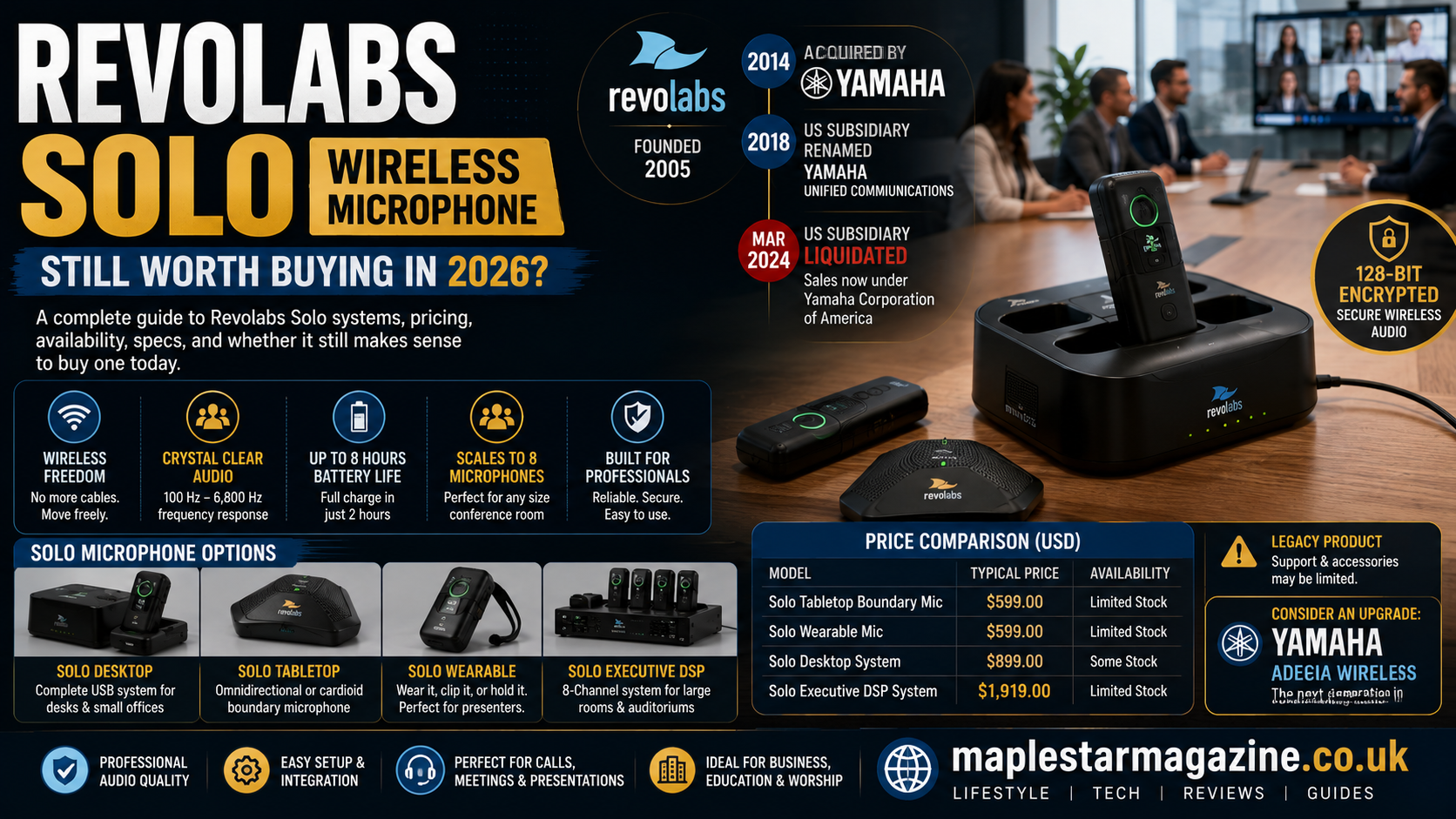
A quick search for the Revolabs Solo wireless microphone turns up plenty of decade-old spec sheets and a handful of listings. Almost nothing explains what actually happened to the company behind it. Revolabs was bought by Yamaha in 2014. The US subsidiary that sold this exact product line was liquidated in March 2024, a detail that changes how any smart buyer should approach a purchase today. This guide covers what the Solo system actually does, what it costs where you can still find it. It also covers whether buying one in 2026 makes sense or whether you should look at Yamaha’s newer conferencing gear instead.
Table of Contents
What Is the Revolabs Solo Wireless Microphone
The Revolabs Solo is a wireless microphone system built for conference rooms, boardrooms and video calls, originally developed by Revolabs, a Sudbury, Massachusetts audio company founded in 2005. Rather than a single product, “Solo” refers to a family of wireless microphones, tabletop units, wearable mics and desktop systems, all designed to connect to a shared charging base station and transmit audio wirelessly to a PC, phone line or PA system.
The core idea was simple for its time: cut the cord on conference room audio without sacrificing the reliability of a wired setup. A base station receives audio from one or more Solo microphones over an encrypted wireless link. It then routes that audio out to a computer via USB, a phone system via an analog or VOIP connection or an external PA system through standard audio outputs.
Revolabs Solo Product Line Explained
The Solo family includes four main microphone types, all built to work with the same charging and receiving infrastructure. The Solo Desktop is a complete self-contained system with its own USB-connected base station, aimed at a single user’s desk or small office for calls and voice recognition software. The Solo Tabletop Boundary microphone sits flat on a conference table and comes in omnidirectional or cardioid pickup patterns, intended for group meetings where multiple people sit around the same surface.
The Solo Wearable microphone clips on with a lanyard or can be handheld, aimed at presenters who need to move around a room. The Solo Executive DSP 8-Channel system scales the whole setup up to eight simultaneous microphones for lecture halls and large boardrooms. An XLR adapter accessory also exists, letting a standard wired dynamic microphone connect into the Solo wireless ecosystem rather than replacing existing mic hardware entirely.
Each microphone type serves a genuinely different use case rather than just offering a cosmetic variation on the same product. A single presenter recording a training video benefits far more from the Wearable’s freedom of movement than from a Tabletop unit fixed in one spot, while a boardroom hosting a weekly leadership call is usually better served by two or three Tabletop units spaced around the table than by a single wearable mic trying to capture everyone in the room.
Revolabs Solo specs at a glance
| Spec | Detail |
| Frequency response | 100 Hz to 6,800 Hz (some listings cite up to 8,000 Hz) |
| Wireless transmission band | 1.92 to 1.93 GHz |
| Battery life | Up to 8 hours of continuous talk time |
| Charge time | Full charge in 2 hours, 80% in 45 minutes |
| Operating range | 65 to 100 feet depending on model |
| Encryption | 128-bit wireless encryption |
| Max simultaneous mics | Up to 8 with the Executive DSP system |
Is Revolabs Solo Still Available in 2026
This is the question most existing product pages never answer. Yamaha Corporation acquired Revolabs outright in 2014 and renamed the US subsidiary Yamaha Unified Communications in 2018. In March 2024, Yamaha announced it was liquidating that US subsidiary, with conferencing equipment sales in the United States moving directly under Yamaha Corporation of America going forward.
Practically, that means the Revolabs Solo line is a legacy product rather than an actively marketed one. Some units, particularly older Solo Desktop and Tabletop models, still turn up in stock at electronics resellers and on secondary marketplaces like eBay. Several accessory listings at major retailers already show as discontinued or out of stock. Yamaha’s own current lineup steers new buyers toward its ADECIA Wireless microphones instead. If you find a Solo system for sale today, treat it as a legacy purchase rather than an actively supported current product. How Yamaha’s ADECIA Line Replaced Revolabs Conferencing Gear.
How Much Does a Revolabs Solo Wireless Microphone Cost
Pricing on a discontinued product line varies more than it would for something still in regular production. At the time of this research, a Solo Series Tabletop Boundary microphone was listed at $256.91 through a major retailer, though marked out of stock, while full Solo Desktop systems and Executive multi-channel setups have historically run from roughly $300 for a single-channel desktop unit up to well over $1,000 for an 8-channel Executive base station with multiple microphones.
Because stock on a legacy product moves unpredictably, expect prices to vary significantly between a still-sealed retailer listing, an open-box unit and a secondhand eBay auction for the same exact model. Budget accordingly and confirm what is actually included, since base stations, microphones and charging trays are sometimes sold separately even within a single product family.
Replacement parts add another layer of cost planning worth factoring in early. A single replacement microphone or charging tray purchased on its own often costs nearly as much as a modest fraction of a full system, since legacy accessory pricing rarely scales down the way bundled system pricing does. If a single component in an existing Solo setup fails, it is worth pricing out a full replacement system alongside the individual part, since the gap between the two is sometimes smaller than expected.
Setting Up and Using the Solo System
Setup follows a similar pattern across the Solo family. The base station connects to its power source. Depending on the model, it also connects to a computer via USB or to a phone system through an analog or VOIP connection. Microphones pair to the base station individually. Most models include a straightforward LED-based pairing indicator to confirm a successful connection before a call starts.
Day to day, the appeal is genuinely simple: a fully charged Solo microphone should run for a full eight-hour workday without needing a mid-meeting battery swap. The out-of-range alarm on most models alerts a presenter if they wander past the effective wireless distance rather than letting audio silently drop out. A 45-minute quick charge during a lunch break restores most of a unit’s capacity if a full recharge is not practical.
Pros and Cons
For its era, the Solo line got a lot right. Genuine 128-bit encryption on the wireless link, immunity to GSM phone interference through RF-Armor shielding on select models and a battery that comfortably outlasts a full workday are all still solid specs by current standards, not just historically competitive ones. The modular product family, mixing tabletop, wearable and desktop options on shared infrastructure, also gave buyers real flexibility to match microphones to a room rather than committing to one form factor.
The clear downside in 2026 is support and availability. Buying new means buying old stock or secondhand hardware with no manufacturer roadmap behind it. Troubleshooting help is likely to point you toward Yamaha’s current ADECIA lineup rather than continued investment in Solo-specific fixes. Frequency response also tops out around 6,800 Hz to 8,000 Hz, adequate for speech but noticeably narrower than modern wideband conferencing audio standards.
Revolabs Solo vs Yamaha ADECIA Wireless
Yamaha’s ADECIA Wireless line is the direct current-generation answer to what Solo did over a decade ago. It is worth understanding the gap before buying either new or secondhand Solo gear, since the two systems are separated by roughly fifteen years of audio and wireless engineering progress.
Solo vs ADECIA Wireless comparison
| Feature | Revolabs Solo | Yamaha ADECIA Wireless |
| Status | Legacy, discontinued from primary channels | Current, actively sold and supported |
| Battery life | Up to 8 hours | Approximately 20 hours per charge |
| Microphone form factors | Tabletop, wearable, desktop, XLR adapter | Gooseneck, tabletop boundary, directional, ceiling |
| Audio processing | Basic wireless transmission | Built-in adaptive echo cancellation in the access point |
| Best fit | Budget or short-term legacy setups | New installations and long-term reliability |
ADECIA Wireless roughly doubles the battery life of the original Solo line and adds processing features, like adaptive acoustic echo cancellation built into the wireless access point itself, that simply were not available when Solo launched. For any new conference room build in 2026, ADECIA is the more defensible long-term choice.
Who Should (and Shouldn’t) Still Buy One
A Revolabs Solo system still makes sense in a narrow set of situations: replacing a single failed microphone in an existing Solo-based conference room without upgrading the entire room’s infrastructure, outfitting a low-budget or temporary setup where eight-hour battery life and basic encryption are genuinely all you need. It also makes sense for picking up a wearable or tabletop unit secondhand at a steep discount for light podcasting or interview use, echoing the original TechCrunch review’s take on it as a solid tool for that exact niche.
It is a poor choice for anyone planning a new conference room installation from scratch, anyone who needs guaranteed manufacturer support or anyone comparing it directly against current wireless conferencing options on pure audio quality and battery life. In those cases, ADECIA Wireless or a comparable current-generation system is the more sensible investment.
Budget is often the deciding factor in practice. A secondhand Solo Tabletop unit can cost a fraction of a new ADECIA microphone, which makes sense for a nonprofit, school or small business stretching a tight equipment budget across several rooms. The tradeoff is accepting that the hardware carries no meaningful warranty and that a failed unit likely means shopping the secondary market again rather than calling a support line.
Where to Buy a Revolabs Solo Wireless Microphone Now
Since Yamaha no longer markets Solo as a current product, availability depends on which resellers still have old inventory. Professional AV resellers and electronics retailers occasionally still list individual Solo components. Secondary marketplaces like eBay carry both new-old-stock and used units, often at a discount versus original list pricing. Confirm exactly which components are included in any listing, since base station, microphone and charging tray are not always bundled. Ask about return policies before buying a legacy electronics product where manufacturer support is limited.
A quick pre-purchase checklist helps avoid disappointment on a legacy product like this. Ask the seller directly whether the unit has been tested recently and whether the battery still holds a reasonable charge, since lithium polymer batteries degrade with age regardless of how lightly a unit was used. Confirm the specific model number matches what you need, since Solo Desktop, Tabletop and Executive components are not interchangeable across every generation of the product line. Finally, photograph or document the condition of anything you buy secondhand, particularly for higher-value Executive multi-channel systems, in case a dispute comes up after the sale.
Frequently Asked Questions
Is Revolabs Solo still supported?
Support is limited. Yamaha liquidated the US subsidiary that handled this product line in March 2024. Conferencing equipment sales and support now run through Yamaha Corporation of America directly, with the company’s active development focus on the newer ADECIA line rather than Solo-specific updates.
What replaced Revolabs Solo?
Yamaha’s ADECIA Wireless line is the direct successor, offering roughly double the battery life and built-in adaptive echo cancellation compared to the original Solo system. ADECIA also expands the microphone form factor options to include gooseneck and ceiling-mount designs.
How long does Revolabs Solo battery last?
Most Solo microphones offer up to 8 hours of continuous talk time on a full charge, with a quick 45-minute charge restoring roughly 80% of capacity. A full recharge from empty typically takes about 2 hours.
Is Revolabs owned by Yamaha?
Yes. Yamaha Corporation acquired Revolabs outright in 2014 and renamed its US subsidiary Yamaha Unified Communications in 2018. That subsidiary was liquidated in March 2024, with Yamaha Corporation of America now handling conferencing equipment sales in the US directly.
Can you still buy Revolabs microphones?
In limited quantities, yes, primarily through remaining retailer stock and secondary marketplaces rather than as an actively marketed current product. Availability and pricing vary significantly since the line is no longer in regular production.
What is the range of a Revolabs Solo microphone?
Operating range runs from about 65 to 100 feet depending on the specific model, with an out-of-range alarm that alerts the presenter if they move beyond the effective wireless distance during a call or presentation.
Final Thoughts
The Revolabs Solo wireless microphone was a genuinely capable system for its time. The core specs, eight-hour battery life, real encryption and a modular lineup of form factors, still hold up reasonably well on paper. What has changed is the company behind it: Yamaha’s 2024 liquidation of the US Revolabs subsidiary means anyone buying Solo gear today is buying a legacy product with Yamaha’s ADECIA Wireless line as the actively supported successor. Check current listings carefully, understand exactly what you are buying. If you are planning a new setup rather than patching an existing one, put ADECIA on your comparison list before committing.

The Maple Star Magazine editorial team is responsible for the accuracy, structure, and publishing standards that every article on this site is held to. This includes verifying sources before publication, maintaining consistency across our Travel, Technology, Lifestyle and revisiting published guides as facts, pricing, or industry standards change. Content published under this byline reflects collaborative editorial work rather than a single author's individual reporting.