








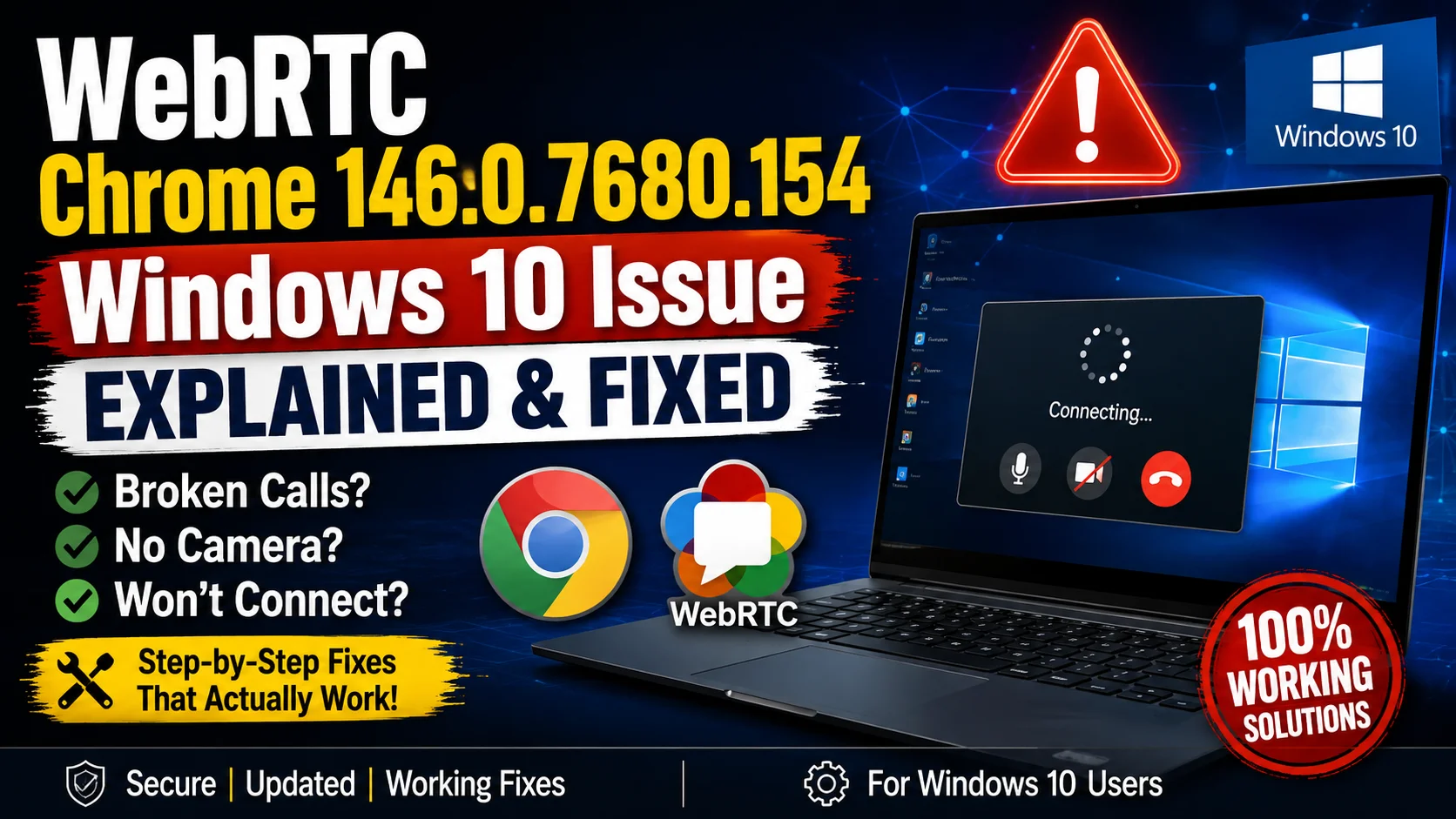
If you landed here searching the exact string “webrtc chrome 146.0.7680.154 windows 10 issue,” you are almost certainly dealing with a broken video call, a missing camera feed or a connection that fails right after your PC restarts. This guide covers what that specific version number actually means, the real security story behind it and every fix that has worked for other Windows 10 users hitting this exact webrtc chrome 146.0.7680.154 windows 10 issue.
Table of Contents
What This Version Number Actually Tells You
Chrome’s version numbers look cryptic. Version 146.0.7680.154 breaks down into useful information once you know how to read it. The 146 is the major release, 7680 identifies the specific build within that release. 154 is the patch number, the small, frequent update Google ships to fix bugs and security issues without waiting for a full new major version. A webrtc chrome 146.0.7680.154 windows 10 issue is, by definition, happening on one of the newest patches within the 146 release line, not on some outdated, long-abandoned build.
That distinction matters more than it sounds. Chrome auto-updates by default, so seeing this exact build number generally means your browser is current, not behind. Whatever is causing the problem is more likely a configuration or environment issue on your specific Windows 10 machine than a browser needing updating. That single fact reframes most of this webrtc chrome 146.0.7680.154 windows 10 issue as a settings problem rather than a software age problem.
Anyone comparing notes with another user experiencing a similar webrtc chrome 146.0.7680.154 windows 10 issue should start by confirming both machines are actually on the identical build, since Chrome occasionally staggers rollouts across a population of users. Two people describing the same symptom might technically be on slightly different builds a day or two apart, which matters when trying to pin down whether a fix worked because of something you changed or because Chrome quietly updated again in the background.
Is Chrome 146.0.7680.154 Patched Against Known WebRTC Vulnerabilities
Here is the security context almost no other guide covering this webrtc chrome 146.0.7680.154 windows 10 issue actually explains. Chrome 146.0.7680.153, the build immediately before this one, shipped as an emergency patch fixing two separate critical vulnerabilities in Chrome’s WebRTC implementation. According to the National Vulnerability Database’s official record, CVE-2026-4445 was a critical use-after-free flaw in WebRTC that could allow an attacker to trigger heap corruption and potentially execute code through a maliciously crafted page. A second flaw, CVE-2026-4463, was a heap buffer overflow, also in WebRTC, capable of similar heap corruption. How Chrome’s Security Patch Numbering Actually Works.
Build 154 is the very next incremental release after that patch, meaning it carries both fixes forward rather than reintroducing the vulnerability. If your webrtc chrome 146.0.7680.154 windows 10 issue is a functional problem, calls not connecting, camera not appearing, it is not related to those two specific security flaws, since both were already resolved one build earlier.
What changed between Chrome 146.0.7680.153 and .154
| Detail | 146.0.7680.153 | 146.0.7680.154 |
| CVE-2026-4445 (use-after-free) | Patched here | Fix carried forward |
| CVE-2026-4463 (heap overflow) | Patched here | Fix carried forward |
| Release type | Emergency security patch | Routine incremental update |
| Security status | Fixed as of this build | Still fixed, no regression reported |
That table confirms the essential fact anyone chasing a webrtc chrome 146.0.7680.154 windows 10 issue needs before troubleshooting further: the security story is already closed.
Common Symptoms of This WebRTC Chrome Windows 10 Issue
Reports of this exact webrtc chrome 146.0.7680.154 windows 10 issue tend to cluster around a handful of specific symptoms rather than one single failure. The most common is a call that simply will not connect, sitting on “Connecting…” indefinitely or dropping immediately after both sides join. A close second is a black or frozen video feed while audio continues working normally. The reverse also happens, working video with no audio at all. A smaller but very specific group of reports describes calls failing only on the first attempt after a full restart, then working normally after that, a pattern this guide addresses directly as its own dedicated webrtc chrome 146.0.7680.154 windows 10 issue below.
Less commonly reported but still worth naming, a handful of users describe a webrtc chrome 146.0.7680.154 windows 10 issue that shows up specifically as choppy or delayed audio rather than an outright failure, often on machines with older or integrated graphics hardware handling more processing load than expected. Distinguishing which specific symptom you are actually facing matters, since the fix that resolves a connection failure is rarely the same fix that resolves choppy audio on an otherwise working call.
Fix One: Camera and Microphone Permissions
The most common cause behind any webrtc chrome 146.0.7680.154 windows 10 issue involving a missing camera or microphone is a permissions mismatch. It exists at two separate levels that both need to be correct. First, check Chrome’s own site-level permission by clicking the lock icon in the address bar and confirming camera and microphone access are set to Allow for the specific site. Second, this is the step most guides skip, confirm your device is not already locked by another application, since Windows only allows one app at a time to access a camera in most configurations, a hidden cause of this webrtc chrome 146.0.7680.154 windows 10 issue.
A quick way to confirm this specific cause is closing every other application that might touch your camera or microphone, video conferencing software, screen recording tools, even a second browser window, before retrying the call. If the webrtc chrome 146.0.7680.154 windows 10 issue disappears once every competing app is closed, hardware contention rather than a genuine Chrome or Windows bug was the actual cause all along.
Fix Two: Windows 10 Privacy Permissions
Beyond Chrome’s own settings, Windows 10 maintains its own separate, OS-level camera and microphone permission system that can block access even when Chrome’s settings look correct. Open Windows Settings, navigate to Privacy, then Camera or Microphone. Confirm that both “Allow apps to access your camera” and the specific toggle for desktop apps are switched on. A webrtc chrome 146.0.7680.154 windows 10 issue caused by this exact mismatch is deceptively common, since Chrome’s own permission prompt can appear to succeed while Windows quietly blocks the actual hardware access behind it.
This two-layer permission system is genuinely one of the more confusing parts of a webrtc chrome 146.0.7680.154 windows 10 issue for anyone unfamiliar with how Windows 10 handles hardware privacy separately from any individual browser. A managed corporate laptop adds a third layer on top of both, since group policy can silently override both Chrome and Windows settings without any visible error message, which is worth checking with an IT administrator if the first two fixes both look correct but the problem persists.
Fix Three: Hardware Acceleration and GPU Settings
Hardware acceleration speeds up video processing by offloading work to your graphics card. A buggy or outdated GPU driver can turn that same feature into the source of a webrtc chrome 146.0.7680.154 windows 10 issue instead. Navigate to chrome://settings, search for hardware acceleration and try toggling it off, then fully restart Chrome to test whether video suddenly starts working. If disabling it fixes the problem, update your graphics driver through Windows Update or your GPU manufacturer’s own tool before turning hardware acceleration back on.
Older Windows 10 machines still running original factory GPU drivers are disproportionately represented among reports of this specific webrtc chrome 146.0.7680.154 windows 10 issue, since driver updates rarely happen automatically the way Chrome itself does. Checking Device Manager for a yellow warning icon next to your display adapter is a quick way to spot a driver problem serious enough to affect video encoding before digging any further into browser-level settings.
Fix Four: Firewall, Antivirus and the UDP Socket Error After Reboot
This is the most specific, well-documented fix for anyone experiencing calls that fail only on the first attempt after a restart. A real case reported through Microsoft’s own Q&A platform describes this exact webrtc chrome 146.0.7680.154 windows 10 issue pattern: the first WebRTC call after a machine boots up fails with a Chrome UDP socket error, code 10053, also known as WSAECONNABORTED, while every subsequent call attempt works normally. The documented cause is a firewall or antivirus rule that blocks or delays outbound UDP traffic specifically during the brief window right after startup, before the security software has fully initialized its own rules.
The fix is to add an explicit firewall rule allowing Chrome’s UDP traffic rather than relying on default rules, particularly on managed corporate machines where a third-party security suite runs alongside Windows Defender. Checking chrome://webrtc-internals right after a failed call will show the exact socket error and confirm whether this specific webrtc chrome 146.0.7680.154 windows 10 issue cause matches your situation.
This particular version of the webrtc chrome 146.0.7680.154 windows 10 issue is worth flagging to any IT department managing a fleet of Windows 10 machines, since the fix scales far better as a centrally deployed firewall rule than as a workaround individual employees discover on their own. A single misconfigured rule pushed through group policy resolves the problem for every affected machine at once rather than requiring each user to diagnose the socket error independently.
Testing WebRTC Independently of Your Own App
Before assuming a webrtc chrome 146.0.7680.154 windows 10 issue is specific to one website, rule out your browser and system as the cause entirely. Google maintains an independent WebRTC test page checking camera, microphone and network connectivity outside any specific application, the fastest way to confirm whether the problem follows you everywhere.
If the independent test also fails, the issue sits with your Chrome installation, your Windows 10 configuration or your network, not with any specific website’s code. If the test passes cleanly, the problem is more likely specific to how one particular site or app implements WebRTC. The fixes above are less likely to help. This single test is the fastest way to separate a genuine webrtc chrome 146.0.7680.154 windows 10 issue from an unrelated problem with one specific service.
The Windows 10 Factor Most Guides Miss
Windows 10 officially reached its end of mainstream support on October 14, 2025. That fact alone does not explain a webrtc chrome 146.0.7680.154 windows 10 issue, since Chrome itself continues to receive full updates on Windows 10 regardless of that milestone. What is worth knowing, what most troubleshooting guides on this topic have not caught up to yet, is that Microsoft quietly extended free Windows 10 Extended Security Updates through October 12, 2027, a full year beyond the originally announced 2026 cutoff. That means critical OS-level security patches, the kind that can affect networking and firewall behavior underneath Chrome, are still actively being delivered to enrolled Windows 10 machines well into 2027, directly relevant to anyone still facing this webrtc chrome 146.0.7680.154 windows 10 issue on an older machine.
That distinction matters for anyone diagnosing a networking-related webrtc chrome 146.0.7680.154 windows 10 issue specifically, since an unpatched or unenrolled Windows 10 machine missing recent OS updates is a meaningfully different troubleshooting scenario than one that is fully current on ESU patches, which itself is worth confirming before assuming Chrome alone is at fault.
When to Report This as a Real Chrome Bug
If none of the fixes above resolve a persistent webrtc chrome 146.0.7680.154 windows 10 issue and the independent WebRTC test also fails consistently, it is worth reporting directly rather than continuing to guess. Chromium’s public bug tracker accepts reports with your exact build number, operating system version and ideally a webrtc-internals log capture from the failed session, which gives Google’s own engineers the specific detail needed to reproduce version-specific problems rather than generic ones already fixed elsewhere.
A well-documented bug report describing a genuine webrtc chrome 146.0.7680.154 windows 10 issue that survives every fix in this guide is far more useful to Google’s engineering team than a vague complaint, since it gives them the exact combination of build number, operating system and reproduction steps needed to confirm whether something new and specific to this release actually needs fixing.
Frequently Asked Questions
Is Chrome 146.0.7680.154 the latest version?
It depends on when you are reading this, since Chrome updates automatically and frequently. What matters more than being the absolute latest build is that 146.0.7680.154 includes the critical WebRTC security fixes shipped one build earlier, in 146.0.7680.153, so a functional webrtc chrome 146.0.7680.154 windows 10 issue is not a security problem.
Why does WebRTC fail after restarting Windows 10 specifically?
A documented case traced this exact webrtc chrome 146.0.7680.154 windows 10 issue to a firewall or antivirus rule blocking outbound UDP traffic briefly during startup, before security software fully initializes, producing a specific socket error, WSAECONNABORTED, on the very first call attempt only.
Does Windows 10 end of support affect Chrome’s WebRTC performance?
Not directly, since Chrome continues receiving full updates on Windows 10. What can matter for a webrtc chrome 146.0.7680.154 windows 10 issue specifically is whether your machine is enrolled in Extended Security Updates, now confirmed to run through October 2027, since OS-level networking patches can affect underlying browser behavior.
How do I check my exact Chrome version?
Open Chrome, click the three-dot menu, select Help, then About Google Chrome. The page displays your exact version number and automatically checks for and installs any available update, which confirms whether you are actually on the build tied to this webrtc chrome 146.0.7680.154 windows 10 issue.
Is my camera issue a Chrome bug or a Windows bug?
Testing on Google’s independent WebRTC test page, separate from your specific site or app, is the fastest way to isolate the cause of a webrtc chrome 146.0.7680.154 windows 10 issue. A failure there points to Chrome or Windows rather than the specific website you were originally using.
Should I downgrade Chrome to fix this issue?
No. Downgrading would remove the critical WebRTC security patches from build .153, reintroducing two confirmed vulnerabilities. Every fix in this guide addresses a webrtc chrome 146.0.7680.154 windows 10 issue without reverting to an older, less secure build.
Final Thoughts
A webrtc chrome 146.0.7680.154 windows 10 issue is rarely about the version number itself, since this specific build already carries forward the critical WebRTC security patches from one release earlier. The real causes are almost always permissions, hardware acceleration or a firewall rule blocking UDP traffic right after a reboot, all of which have documented, working fixes. Work through the fixes in order, test independently before assuming a specific website is at fault. Report a genuinely persistent webrtc chrome 146.0.7680.154 windows 10 issue to Chromium’s bug tracker with your exact build number if nothing here resolves it.

The Maple Star Magazine editorial team is responsible for the accuracy, structure, and publishing standards that every article on this site is held to. This includes verifying sources before publication, maintaining consistency across our Travel, Technology, Lifestyle and revisiting published guides as facts, pricing, or industry standards change. Content published under this byline reflects collaborative editorial work rather than a single author's individual reporting.