








A large national survey of US adults found that only 5.5% identified with a purely anxious attachment style, while a combined 30% or more showed some form of insecure pattern once avoidant and unclassified responses were counted. Anxious avoidant attachment style describes one of the most misunderstood of these patterns: wanting closeness intensely while also fearing it, sometimes in the same conversation.
This guide from our lifestyle desk explains where this pattern actually comes from, how it differs from anxious and avoidant attachment on their own, and what research says about whether it can change.
Table of Contents
What Is Anxious-Avoidant Attachment? A Quick Definition
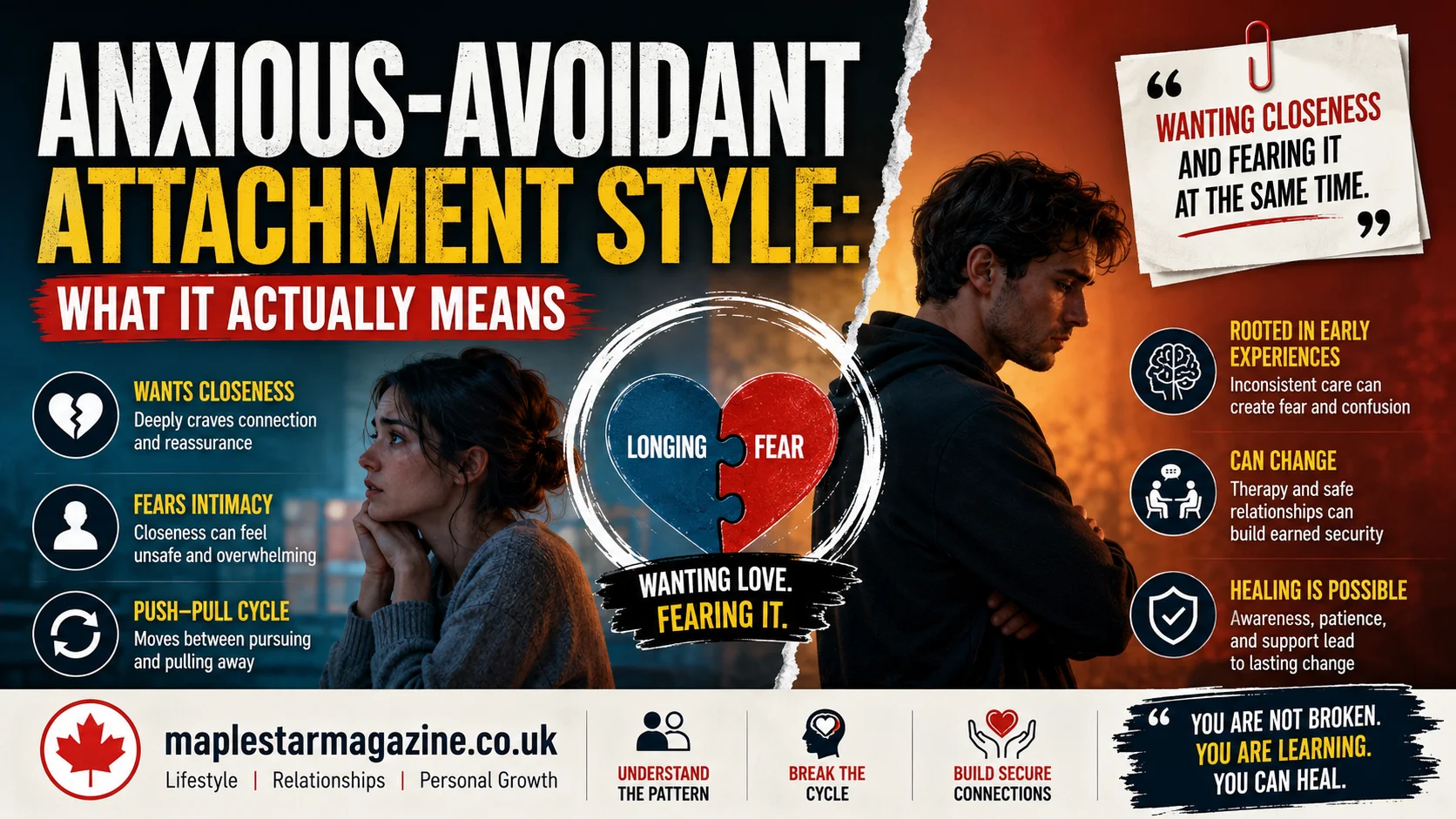
Anxious-avoidant attachment, also called fearful-avoidant or disorganized attachment, describes a relationship pattern combining high attachment anxiety with high avoidance. A person with this pattern deeply wants closeness and reassurance, and simultaneously feels unsafe once they get it, which produces a push-pull cycle rather than one consistent behavior.
It sits apart from the two better-known insecure styles. Anxious attachment alone seeks closeness without much fear of it. Avoidant attachment alone keeps distance without much longing for connection. Anxious-avoidant attachment holds both forces at once.
Where Attachment Theory Comes From
Psychiatrist John Bowlby developed the original framework in the mid-20th century, and researcher Mary Ainsworth identified the first three attachment patterns through her Strange Situation studies of infants and caregivers. In 1986, researchers Mary Main and Judith Solomon identified a fourth pattern in children who showed contradictory, disorganized behavior toward caregivers, which later research by Kim Bartholomew and Leonard Horowitz translated into the adult four-category model still used today: secure, preoccupied, dismissing, and fearful.
This lineage matters because it shows the concept did not emerge from pop psychology. It developed over roughly five decades of observational research, first watching how infants responded when separated briefly from a caregiver, then extending those same categories into adult romantic relationships once researchers noticed the parallels.
Common Signs of Anxious-Avoidant Attachment
Recognizing anxious-avoidant attachment in yourself or someone close to you usually means noticing a set of contradictions rather than one steady behavior.
- Wanting deep closeness while also feeling panicked once a relationship becomes genuinely close
- Alternating between pursuing a partner and pulling away without an obvious external trigger
- Difficulty trusting a partner’s reassurance, even when it is genuine and consistent
- A negative view of both self and others, unlike anxious or avoidant attachment, which usually holds a negative view of only one
- Strong emotional reactions that feel confusing even to the person experiencing them
None of these signs alone confirms this pattern, and most people show a few insecure traits at different points in life without the fuller pattern being present. It is the combination and the persistence across relationships that distinguishes anxious-avoidant attachment from an ordinary rough patch.
What Causes This Pattern to Develop?
Understanding where anxious-avoidant attachment actually comes from matters more than memorizing its symptoms, since the cause shapes how the pattern eventually gets addressed.
Research points most often to early caregiving that was simultaneously a source of comfort and a source of fear. A caregiver who was frightening, unpredictable, or frightened themselves can leave a child with no consistent strategy for seeking safety, since the person meant to provide it was also the source of distress. That contradiction in early life is what researchers believe produces the contradictory pattern in adulthood. Later life experiences, including trauma in adult relationships, can also reinforce or, in some cases, produce similar patterns even without a difficult childhood.
Anxious-Avoidant vs. Anxious vs. Avoidant: How They Differ
Anxious attachment fears abandonment and seeks reassurance persistently. Avoidant attachment values independence and minimizes emotional need. Anxious-avoidant attachment does not sit between these two so much as cycle between them, which is why it is often the hardest of the three insecure styles for both the person and their partner to predict.
A useful way to picture the difference: an anxiously attached person mostly stays close and worries. An avoidantly attached person mostly stays distant and self-sufficient. Someone with anxious-avoidant attachment does both, sometimes within the same hour, which is precisely what makes the pattern so disorienting to live with and so easy to misread from the outside as simple unpredictability.
How This Pattern Shows Up Beyond Romantic Relationships
While most discussion of anxious-avoidant attachment focuses on romantic partnerships, the same push-pull dynamic often appears in friendships and even workplace relationships. A close friendship might follow a similar cycle of intense connection followed by sudden distancing, and the same fear of both closeness and abandonment can shape how someone relates to a mentor or a close colleague, not just a romantic partner.
Can Attachment Style Actually Change?
This is the question that matters most to anyone who recognizes anxious-avoidant attachment in their own relationships, and the honest answer is genuinely hopeful.
Yes, and this is the part most casual content skips. Attachment researchers use the term earned secure attachment to describe adults who move from an insecure pattern toward secure functioning, typically through consistent, safe relationships and therapeutic work that helps the nervous system learn a new, more coherent response to closeness.
A Real Example: The Push-Pull Pattern in a Relationship
A common relationship pattern looks like this: one partner asks for more closeness, more communication, more reassurance, and receives it. Within days, the same partner starts creating distance, canceling plans or picking fights over minor issues, without fully understanding why. From the outside, this can look like manipulation or mixed signals. From the inside, it often reflects a genuine, if confusing, internal conflict: closeness feels necessary and unsafe at the same time, and the pulling away is an attempt to regulate fear, not a calculated strategy.
Partners on the receiving end of anxious-avoidant attachment often describe feeling like they are chasing a moving target, since the same behavior that was welcomed last week gets rejected this week. Understanding that the shift usually tracks an internal fear response, not a change in how the relationship is actually going, tends to reduce the confusion considerably, even before anything else changes.
The Four Attachment Styles Compared
| Style | View of Self | View of Others | Core Pattern |
| Secure | Positive | Positive | Comfortable with closeness and independence |
| Anxious (preoccupied) | Negative | Positive | Seeks closeness, fears abandonment |
| Avoidant (dismissing) | Positive | Negative | Values independence, minimizes closeness |
| Anxious-avoidant (fearful) | Negative | Negative | Wants closeness, fears it at the same time |
Working through a pattern like this takes real, sustained effort. Our guide on how to stay motivated every day covers habits that support slow, meaningful change when the payoff is not immediate.
Analysis and Insights
The counterintuitive insight in the research is that anxious avoidant attachment is not actually chaotic once you understand the underlying logic. The push-pull cycle that looks inconsistent from the outside is a coherent, if painful, strategy: seek closeness when the fear of abandonment dominates, retreat when the fear of engulfment takes over. Naming that pattern accurately, rather than labeling it as manipulation or as simple inconsistency, tends to be the first real turning point for people trying to understand their own relationships or a partner’s behavior.
One honest limitation: attachment style labels, including anxious-avoidant attachment, are descriptive research categories, not formal clinical diagnoses in the DSM-5, and a short online quiz cannot substitute for a licensed therapist’s assessment. Treat this guide as a framework for understanding a pattern, not a verdict on yourself or anyone else.
Practical Recommendations for Working With This Pattern
1. Name the Pattern Without Using It as a Label
Recognizing “I am pulling away because closeness feels unsafe right now” is useful. Using “I’m just fearful-avoidant” as a permanent identity tends to close off the possibility of change instead of opening it up, since anxious-avoidant attachment describes a pattern, not a fixed trait.
2. Communicate the Cycle to a Partner Before It Happens
Explaining the push-pull pattern in a calm moment, rather than in the middle of it, gives a partner context that makes the behavior far less confusing and hurtful when it does show up.
3. Work With a Therapist Trained in Attachment-Based Approaches
Modalities like Emotionally Focused Therapy specifically address attachment patterns in relationships and are among the most researched approaches for working through anxious-avoidant attachment specifically, rather than generic relationship advice.
4. Build a Pause Between Feeling and Reacting
A short pause, even 60 seconds, before responding to the urge to withdraw or over-pursue gives the rational brain time to catch up with the fear response driving the reaction. Something as simple as stepping outside or taking five slow breaths before replying to a triggering message can interrupt a pattern that otherwise feels automatic.
5. Seek Out Consistently Safe Relationships
Earned security tends to develop through repeated experience with people who remain steady and non-threatening, even during conflict, not through insight alone. This includes friendships and family relationships, not only romantic partners, since any consistent, safe relationship can contribute to the same underlying sense of security.
6. Expect Gradual Change, Not a Sudden Shift
Attachment patterns formed over years of early experience do not resolve in weeks. Consistent small changes in how you respond to closeness matter more than any single breakthrough moment.
Frequently Asked Questions
| Q: What is anxious avoidant attachment style? A: It is an insecure attachment pattern combining high attachment anxiety with high avoidance, often called fearful-avoidant or disorganized attachment, in which a person wants closeness and fears it at the same time. |
| Q: Is anxious-avoidant attachment the same as disorganized attachment? A: Largely yes. Disorganized is the term used for this pattern in children, while fearful-avoidant or anxious-avoidant is the more common term for the same pattern in adults. |
| Q: What causes anxious-avoidant attachment? A: Research points most often to early caregiving that was inconsistently frightening or unpredictable, leaving a child without a stable strategy for seeking comfort from the person who was also a source of fear. |
| Q: How is anxious-avoidant different from just being anxious or avoidant? A: Anxious attachment seeks closeness without much fear of it, and avoidant attachment avoids closeness without much longing for it. Anxious-avoidant attachment cycles between both, wanting and fearing closeness simultaneously. |
| Q: Can someone with anxious-avoidant attachment have a healthy relationship? A: Yes. With awareness, communication, and often therapeutic support, people with this pattern can build genuinely secure, stable relationships over time. |
| Q: Does attachment style ever change? A: Yes. Researchers use the term earned secure attachment to describe adults who move from an insecure pattern toward secure functioning through consistent safe relationships and therapeutic work. |
| Q: Should I diagnose my own attachment style using an online quiz? A: Online quizzes can offer a useful starting point for reflection, but they are not a clinical assessment. A licensed therapist can provide a more accurate and personalized understanding of your specific patterns. |
Conclusion
Anxious avoidant attachment style describes a genuine, researched pattern: wanting closeness and fearing it at the same time, usually rooted in early caregiving that mixed comfort with fear. Understanding the pattern accurately is useful. Changing it, when it is genuinely disrupting relationships, is real work best supported by a licensed therapist rather than a label alone. The research is genuinely encouraging on this point: this pattern is not a permanent sentence, and earned security is a well-documented outcome for people who put in the work.
- Anxious-avoidant attachment combines high anxiety with high avoidance, unlike anxious or avoidant alone
- It traces to Bowlby, Ainsworth, and later Main, Solomon, Bartholomew, and Horowitz’s research
- The push-pull cycle is a coherent fear response, not manipulation or random inconsistency
- Earned secure attachment is a real, researched outcome of sustained safe relationships and therapy
- This is a descriptive pattern, not a formal diagnosis, so treat any quiz result as a starting point
Does this push-pull pattern sound familiar, in yourself or someone close to you? Share your experience in the comments, and if it resonates strongly, consider bringing it to a licensed therapist rather than carrying it alone.

The Maple Star Magazine editorial team is responsible for the accuracy, structure, and publishing standards that every article on this site is held to. This includes verifying sources before publication, maintaining consistency across our Travel, Technology, Lifestyle and revisiting published guides as facts, pricing, or industry standards change. Content published under this byline reflects collaborative editorial work rather than a single author's individual reporting.