








Researchers at the University of Georgia found in a 2025 study that adults who took up piano showed measurable gains in reasoning and memory compared to those who only listened to music. You do not need years of lessons to get started or to feel that first rush of playing something real. Easy piano songs exist for exactly this reason: familiar, recognizable pieces that beginners can actually finish within the first few weeks.
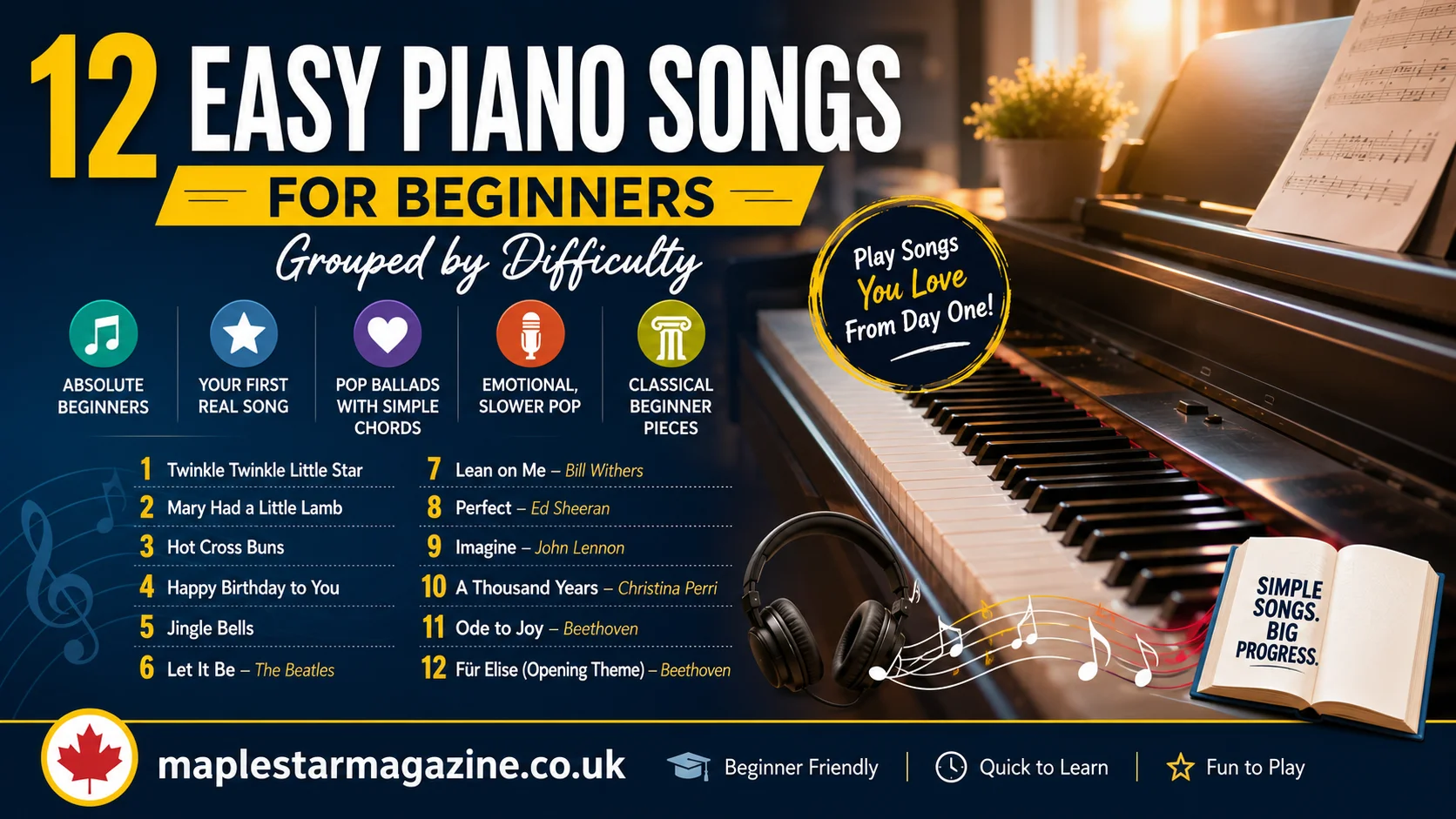
This guide from our lifestyle desk groups 12 easy piano songs for beginners by difficulty, from your very first nursery tune to your first pop ballad.
Table of Contents
What Makes a Piano Song Easy for Beginners?
Easy piano songs share four traits: a melody that mostly stays within one hand position, a small number of repeating chords, a familiar tune you already know by ear, and no wide octave jumps or complex rhythms. A song can sound impressive and still be genuinely simple to play.
Interestingly, one of the most beginner-friendly songs of all, “Happy Birthday to You,” only entered the public domain in 2016 after a long copyright dispute, which is why so many teachers use it as a universally available first song.
Best for Absolute Beginners
These three songs use only a handful of notes and rarely leave a five-finger hand position, making them the standard starting point in most beginner method books. Nearly every list of easy piano songs for beginners opens with at least one of these three.
1. Twinkle Twinkle Little Star
A single-hand melody using just a few adjacent notes, this traditional tune is usually the very first song a new piano student plays from memory.
Difficulty: Very easy Best For: Complete first-timers, including kids
2. Mary Had a Little Lamb
Simple, stepwise, and repetitive, this nursery tune teaches basic single-hand melody playing without requiring any chord knowledge at all.
Difficulty: Very easy Best For: Building basic note-reading confidence
3. Hot Cross Buns
Often taught in the very first lesson, this three-note tune introduces the idea of playing a full, recognizable song in under a minute of practice.
Difficulty: Very easy Best For: A first “can I actually do this” win
Best for Your First “Real Song”
These two step up slightly in scope while staying firmly beginner-friendly, and both double as genuinely useful party pieces.
4. Happy Birthday to You
Everyone already knows this melody by ear, which removes half the usual learning curve. The most demanding moment is a single octave stretch, easily manageable for most adult hands.
Difficulty: Easy Best For: A song you can actually use at a real party
5. Jingle Bells
The verse and chorus both use straightforward, repeating patterns, with just enough melodic variation to stay interesting through multiple practice rounds.
Difficulty: Easy Best For: Holiday sing-alongs with family
Best Pop Ballads with Simple Chords
Each of these relies on three to four repeating chords, which is exactly the kind of structure that makes modern pop songs so approachable for new players. This is where easy piano songs for beginners start sounding like the music you actually hear on the radio.
6. Let It Be by The Beatles
Built almost entirely on a handful of repeating chords, this is one of the most frequently recommended first pop songs among piano teachers, since the left hand stays predictable throughout.
Difficulty: Easy to moderate Best For: A first real pop song with a strong hook
7. Lean on Me by Bill Withers
A steady, gospel-influenced chord pattern repeats through most of the song, making it a favorite for beginners who want a soulful sound without complex fingering.
Difficulty: Easy to moderate Best For: Players who enjoy a warmer, soulful tone
8. Perfect by Ed Sheeran
A gentle, repeating chord progression underlies the entire song, and the melody moves slowly enough for beginners to keep pace without rushing.
Difficulty: Easy to moderate Best For: A modern, romantic-sounding first pop piece
Best for Emotional, Slower Pop
Slower tempo does not mean harder. Both of these give beginners more time between chord changes, which often makes them easier than faster songs.
9. Imagine by John Lennon
The unhurried tempo gives beginners extra time to find each chord, and the simple, repeating left-hand pattern rarely changes throughout the song.
Difficulty: Easy to moderate Best For: A reflective, slower-paced practice piece
10. A Thousand Years by Christina Perri
A recognizable, steady chord pattern anchors the whole piece, and the melody sits comfortably within a beginner’s hand range for most of the song.
Difficulty: Moderate Best For: Players who want an emotional, cinematic sound
Best Classical Beginner Pieces
Classical music has a reputation for being intimidating, but these two beginner-level excerpts are genuinely approachable, especially in simplified arrangements. They round out this list of easy piano songs for beginners with something a little more timeless.
11. Ode to Joy by Beethoven
The famous main theme uses simple, stepwise motion and repeating phrases, making it one of the most commonly assigned first classical pieces for new students.
Difficulty: Easy Best For: A first taste of classical repertoire
12. Für Elise (Opening Theme) by Beethoven
The instantly recognizable opening phrase is genuinely playable for beginners, even though the full piece grows considerably more demanding later on.
Difficulty: Easy (opening only) Best For: Learning a famous excerpt without tackling the whole piece
A Real Example: Learning Your First Song in a Month
A common pattern among adult beginners looks like this: two weeks spent on Twinkle Twinkle Little Star and Hot Cross Buns to build basic finger independence, followed by two more weeks moving into Happy Birthday to You, hands separately at first and then together. By the end of the first month, most beginners can play one full, recognizable song from memory, which tends to matter more for staying motivated than any amount of scale practice.
The specific choice of easy piano songs for beginners in that first month matters less than simply choosing something and finishing it. A finished simple song beats an abandoned harder one every time, especially in the fragile first weeks when motivation is still being built.
Quick Reference: All 12 Songs at a Glance
| Song | Style | Difficulty |
| Twinkle Twinkle Little Star | Nursery | Very easy |
| Mary Had a Little Lamb | Nursery | Very easy |
| Hot Cross Buns | Nursery | Very easy |
| Happy Birthday to You | Traditional | Easy |
| Jingle Bells | Holiday | Easy |
| Let It Be | Pop | Easy to moderate |
| Lean on Me | Pop/Soul | Easy to moderate |
| Perfect | Pop | Easy to moderate |
| Imagine | Pop | Easy to moderate |
| A Thousand Years | Pop | Moderate |
| Ode to Joy | Classical | Easy |
| Für Elise (opening) | Classical | Easy (opening only) |
Staying consistent matters more than any single song choice. Our guide on how to stay motivated every day covers the same habit-building principles that keep a new piano practice from fading out after the first exciting week.
Analysis and Insights
The counterintuitive insight is that most adult beginners quit not because piano is too hard, but because they start with standard sheet music before they can read it fluently, instead of starting with easy piano songs taught by ear or simplified letter notation. Waiting to play a real, recognizable tune until full music literacy arrives removes the exact reward that keeps beginners motivated during the slow early weeks. Playing something you recognize, even imperfectly, does more for staying power than perfect technique on an exercise no one enjoys.
One honest limitation: letter-note or simplified beginner arrangements are a genuinely useful bridge, not a permanent substitute for learning standard notation. Relying on them indefinitely caps how far a player can progress, so treat this list as a motivating starting point, not the whole journey.
Practical Recommendations for Learning Your First Songs
1. Learn Each Hand Separately Before Combining Them
Trying to coordinate both hands from day one is the single biggest source of frustration for new players. Master the right-hand melody, then the left-hand part, before putting them together.
2. Practice Slowly With a Metronome Before Speeding Up
Playing a song correctly at half speed builds far more lasting skill than rushing through it at full tempo with mistakes baked in.
3. Master One Phrase Before Moving to the Next
Breaking a song into four-bar sections and mastering each one individually prevents the frustration of restarting from the beginning every time you stumble.
4. Do Not Skip the Left Hand
It is tempting to focus entirely on the melody, but the left hand builds the coordination and independence that every future song will require.
5. Use Letter-Note Sheets as a Bridge, Not a Permanent Crutch
Simplified notation is a legitimate way to start, but gradually cross-reference it with standard sheet music so you are building real reading skills alongside your song list.
6. Finish One Full Song Before Starting the Next
Jumping between half-learned songs feels productive but rarely builds real progress. Completing one song, even imperfectly, teaches more than three abandoned attempts.
Frequently Asked Questions
| Q: What are the easiest piano songs for complete beginners? A: Twinkle Twinkle Little Star, Mary Had a Little Lamb, and Hot Cross Buns are the most commonly taught first songs, since each uses only a handful of adjacent notes in one hand position. |
| Q: Can I learn easy piano songs without reading sheet music? A: Yes. Many beginners start with letter-note notation or by ear before transitioning to standard sheet music, which is a legitimate and common way to build early motivation. |
| Q: How long does it take to learn an easy piano song as a beginner? A: Most simple nursery tunes can be learned within one to two weeks of short daily practice, while pop songs with more chords typically take three to six weeks for a new player. |
| Q: What is the easiest pop song to play on piano? A: Let It Be by The Beatles is frequently recommended as a first pop song, since it relies on a small set of repeating chords and a predictable left-hand pattern. |
| Q: Is classical music too hard for piano beginners? A: Not necessarily. Simplified arrangements of pieces like Beethoven’s Ode to Joy or the opening theme of Für Elise are genuinely approachable for beginners, even though the full compositions are more advanced. |
| Q: Do I need a real piano or is a keyboard enough for beginners? A: A keyboard with weighted or semi-weighted keys is enough to start learning easy piano songs. A full piano becomes more important later, once dynamics and touch sensitivity matter more. |
| Q: Does learning piano actually have cognitive benefits for adults? A: Yes. A 2025 University of Georgia study found that adults who received piano training showed measurable improvements in reasoning and memory compared to a control group that only listened to music. |
Conclusion
Easy piano songs work because they give beginners a real, finished result within weeks, not months. Start with a nursery tune or two to build finger independence, move into a familiar pop ballad once basic coordination feels natural, and let one finished song lead you to the next. Whichever easy piano songs you pick first, finishing them matters more than picking the perfect one.
- Nursery tunes like Twinkle Twinkle Little Star build core finger independence fastest
- Pop songs with 3–4 repeating chords, like Let It Be, make strong second-stage pieces
- Simplified classical excerpts are more approachable than their reputation suggests
- A 2025 University of Georgia study links piano practice to real cognitive benefits in adults
- Finishing one full song matters more for motivation than perfecting scales
Which song are you starting with: a nursery tune, a pop ballad, or a classical piece? Tell us in the comments and we will help you pick the next one.

The Maple Star Magazine editorial team is responsible for the accuracy, structure, and publishing standards that every article on this site is held to. This includes verifying sources before publication, maintaining consistency across our Travel, Technology, Lifestyle and revisiting published guides as facts, pricing, or industry standards change. Content published under this byline reflects collaborative editorial work rather than a single author's individual reporting.