









Mailchimp, Basecamp, and Canva all reached real profitability before a single venture capital check ever cleared. “Booted” is shorthand for bootstrapped, and startup booted financial modeling is simply the practice of forecasting your company’s future using the revenue you actually generate, not money you hope to raise. Get this model wrong and a growing, popular business can still run out of cash. Get it right and every hiring decision, price change, and marketing dollar has a number behind it instead of a guess.
This guide from our lifestyle desk walks through the core numbers, a real worked example, and the mistakes that sink self-funded founders most often.
Table of Contents
What Is Startup Booted Financial Modeling?
Startup booted financial modeling is the process of forecasting a company’s revenue, expenses, cash flow, and profitability using internally generated income instead of venture capital. Every projection, hiring decision, and spending choice gets tested against money the business has actually earned, not money it expects to raise.
The word choice matters less than the discipline behind it. Whether a founder calls it booted, bootstrapped, or self-funded modeling, the underlying job is identical: turn real revenue and real costs into a forecast that tells you, honestly, how many months of runway you have left.
Search interest in the exact phrase startup booted financial modeling has grown alongside a broader shift toward revenue-first founding, partly because raising venture capital has gotten harder to secure and partly because more founders are choosing self-funded growth on purpose rather than by necessity.
The Five Core Numbers Every Model Needs
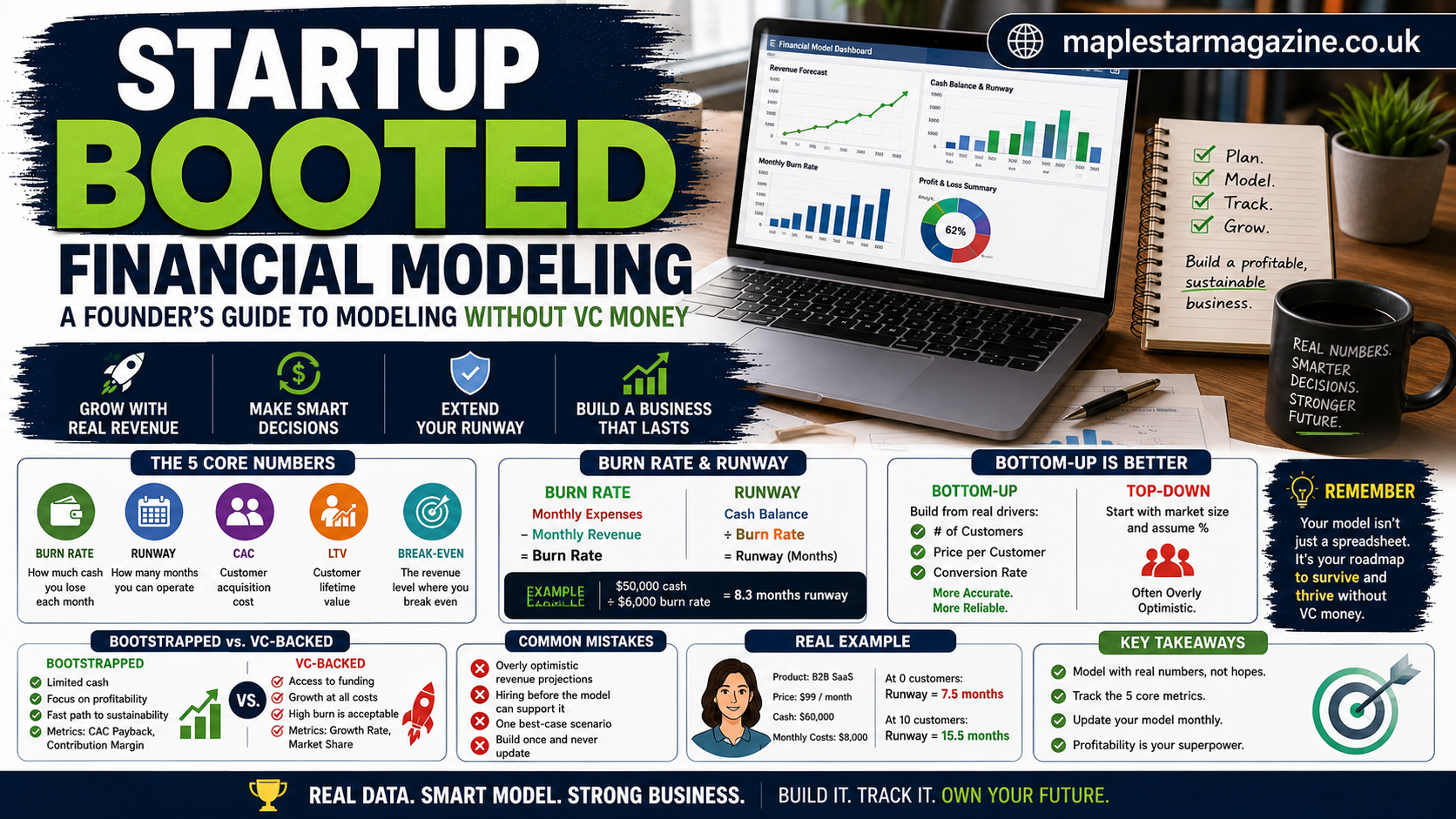
A bootstrapped model does not need to be complicated, but it does need these five numbers tracked consistently. Every serious approach to startup booted financial modeling starts here, regardless of industry or business size.
- Burn rate: how much cash the business loses each month
- Runway: how many months of operation remain at the current burn rate
- Customer acquisition cost (CAC): total marketing spend divided by new customers gained
- Lifetime value (LTV): total revenue a customer generates over the full relationship
- Break-even point: the revenue level where income finally covers expenses
Track these five consistently and startup booted financial modeling stops being an abstract exercise and starts functioning as an actual early-warning system for the business.
How to Calculate Burn Rate and Runway
These two numbers sit at the center of nearly every real startup booted financial modeling exercise, since they answer the single most urgent question a founder faces: how much time is actually left.
Burn rate is monthly expenses minus monthly revenue. Runway is your cash balance divided by that burn rate. If a founder has $50,000 in the bank and burns $6,000 net per month, the math is straightforward: $50,000 ÷ $6,000 ≈ 8.3 months of runway. The SBA recommends especially detailed month-by-month projections during a company’s first year, precisely because this number moves the most while a business is still young.
Bottom-Up vs. Top-Down Forecasting
Bottom-up forecasting builds revenue from real, specific drivers: number of customers, price per customer, expected conversion rate. Top-down forecasting starts from a market size and assumes a small percentage of it. Bootstrapped founders should lean almost entirely on bottom-up numbers, since assuming even one percent of a large market is a common way overly optimistic models quietly become fiction.
This choice matters more in startup booted financial modeling than almost anywhere else, because a founder relying on real revenue cannot afford to discover eighteen months in that the top-down assumption never matched actual demand.
Bootstrapped vs. VC-Backed Models: What’s Different
A venture-backed model can tolerate heavy, sustained burn in pursuit of speed, because more funding is assumed to arrive. A bootstrapped model cannot make that assumption. It has to convert revenue into stability fast enough to protect the company on its own, which is why metrics like CAC payback period and contribution margin carry more weight in a self-funded business than growth rate alone.
Founders moving between the two worlds often describe the mental shift as the hardest part. A venture-backed instinct toward growth-at-all-costs has to be deliberately unlearned before startup booted financial modeling actually sticks as a daily habit.
Common Mistakes That Sink Bootstrapped Models
Overly optimistic revenue assumptions, hiring before the model can actually support a new salary, and treating a single best-case projection as the plan are the three mistakes that appear most often. A model built entirely around hockey-stick growth from month one rarely survives contact with an actual sales cycle.
A quieter mistake is building the model once and never returning to it. Startup booted financial modeling only works as a living process, checked against real numbers monthly, not as a one-time spreadsheet exercise completed before launch and then forgotten in a folder.
A Real Example: One Founder’s Actual Numbers
Picture a solo founder running a B2B software tool priced at $99 a month. She has $60,000 in savings invested in the business and monthly costs of $8,000, covering software, a part-time contractor, and basic tools. At zero customers, her runway is exactly 7.5 months: $60,000 divided by $8,000. Every customer she signs extends that runway, which is precisely why her financial model, not her gut feeling, tells her whether she can afford to hire a second contractor this quarter or needs to wait two more months of revenue growth first.
That single number, runway, becomes the filter for every decision she makes. A new marketing tool that costs $200 a month is not evaluated on whether it sounds useful. It is evaluated on how many weeks of runway it costs and whether the customers it might bring in will pay that back before the business runs out of cash.
Six months later, with 40 paying customers and revenue covering most of her fixed costs, the same startup booted financial modeling exercise looks completely different. The question has shifted from whether she can survive to whether she can afford to grow faster, which is exactly the kind of shift a well-maintained model is supposed to reveal on its own, without a founder needing to guess.
Bootstrapped vs. VC-Backed Models at a Glance
| Factor | Bootstrapped Model | VC-Backed Model |
| Primary funding source | Customer revenue and founder capital | Investor capital |
| Growth pace | Matched to what revenue can sustain | Often prioritized over near-term profitability |
| Key metric | Runway and break-even | Growth rate and market share |
| Risk tolerance for burn | Low, cash-constrained by design | Higher, backed by future funding rounds |
| Forecasting style | Bottom-up, conservative | Often top-down, growth-assumption heavy |
Solo founders juggling this alongside everything else benefit from tighter daily structure. Our guide on work from home productivity tips covers habits that protect focused time for the financial planning work that is easy to keep postponing.
Analysis and Insights
The counterintuitive insight is that startup booted financial modeling often produces more disciplined, not less sophisticated, forecasts than venture-backed modeling. When a founder’s own household budget and business survival are tied directly to the same bank balance, every assumption gets scrutinized in a way that a well-funded model, cushioned by an assumed next round, rarely receives. Necessity, in this specific case, tends to produce better financial habits than abundance does.
One honest limitation: even a well-built model is only as good as its assumptions, and no spreadsheet can substitute for actually talking to customers and watching real revenue arrive. Treat every projection produced through startup booted financial modeling as a working hypothesis to test against reality each month, not a fixed prediction to defend.
Practical Recommendations for Building Your Model
1. Update Your Model Monthly, Not Quarterly
Cash problems become visible weeks before they become emergencies, but only if you are actually looking. A monthly update catches a widening gap between plan and reality while there is still time to react, and it is the single habit that separates founders who treat startup booted financial modeling as ongoing practice from those who treat it as a launch-day formality.
2. Build Three Scenarios, Not One
Model a best case, a realistic case, and a worst case. Make hiring and spending decisions based on the worst case that still leaves at least a few months of runway, not the optimistic middle scenario.
3. Track CAC Payback Period, Not Just CAC
Knowing what a customer costs to acquire matters less than knowing how many months it takes to earn that cost back. A shorter payback period means less cash tied up waiting to be recovered.
4. Keep Fixed Costs Deliberately Low
Fixed costs do not shrink when a slow month hits, which makes them the fastest way to erode runway during a downturn. Favor variable, usage-based costs wherever the tradeoff is reasonable.
5. Separate Must-Have Spend From Nice-to-Have Spend
Label every line item honestly. A tool that would be nice to have gets cut first in a worst-case scenario, and knowing that in advance makes a real cash crunch far less chaotic to navigate.
6. Start With a Free Template Before Buying Software
A basic spreadsheet built from a free, reputable template covers most early-stage needs. Paid modeling software earns its cost later, once the business has enough complexity to justify it, and most founders discover that startup booted financial modeling in a simple spreadsheet works fine well past the first year.
Frequently Asked Questions
These are the questions we hear most often from founders just starting to take startup booted financial modeling seriously.
| Q: What is startup booted financial modeling? A: It is the practice of forecasting a startup’s revenue, expenses, and cash flow using internally generated income instead of venture capital, so every spending decision is grounded in real, earned money rather than assumed future funding. |
| Q: What does “booted” mean in this context? A: Booted is shorthand for bootstrapped, meaning a company funds its own growth through customer revenue and founder capital rather than outside investment. |
| Q: How do you calculate startup runway? A: Divide your current cash balance by your monthly burn rate. A company with $50,000 in the bank and a $6,000 monthly burn rate has roughly 8.3 months of runway. |
| Q: What is a good burn rate for a bootstrapped startup? A: There is no universal number. A solo founder running a service business might burn $2,000 to $5,000 a month, while a small product startup with contractors might burn $10,000 to $20,000. What matters is knowing your specific number and matching it to your revenue timeline. |
| Q: Do bootstrapped startups need a financial model if they have no investors? A: Yes, arguably more than a funded startup does. Without an investor cushion, a bootstrapped founder needs the model to make real-time decisions about hiring, spending, and pricing. |
| Q: What is the difference between bottom-up and top-down forecasting? A: Bottom-up forecasting builds revenue from specific, real drivers like customer count and pricing. Top-down forecasting assumes a percentage of a large market, which tends to produce overly optimistic, less grounded projections. |
| Q: Can a bootstrapped startup switch to a VC-backed model later? A: Yes. Many founders bootstrap to prove real demand and healthy unit economics first, then raise outside capital to accelerate growth once the fundamentals are already validated. |
| Q: What tools do I need to start startup booted financial modeling? A: A basic spreadsheet is enough to start. Free templates from organizations like SCORE cover income statements, cash flow, and break-even analysis without requiring paid software. |
Conclusion
Startup booted financial modeling comes down to five numbers, tracked honestly and updated often: burn rate, runway, CAC, LTV, and break-even. None of them require complex software to start, and all of them matter more to a self-funded founder than to one with a funding round to fall back on. The founders who treat this as a monthly habit, not a one-time launch document, are the ones who still have real choices left when a slow month eventually arrives.
- Booted is shorthand for bootstrapped: growth funded by revenue, not venture capital
- Runway equals cash balance divided by monthly burn rate
- Bottom-up forecasting produces more reliable numbers than top-down market-share guesses
- Real companies like Mailchimp, Basecamp, and Canva proved profitability before ever raising VC
- Update the model monthly and plan around the worst case, not the optimistic one
Are you building your first financial model, or refining one that already exists? Tell us in the comments which number, burn rate, CAC, or runway, gives you the most trouble.

The Maple Star Magazine editorial team is responsible for the accuracy, structure, and publishing standards that every article on this site is held to. This includes verifying sources before publication, maintaining consistency across our Travel, Technology, Lifestyle and revisiting published guides as facts, pricing, or industry standards change. Content published under this byline reflects collaborative editorial work rather than a single author's individual reporting.