








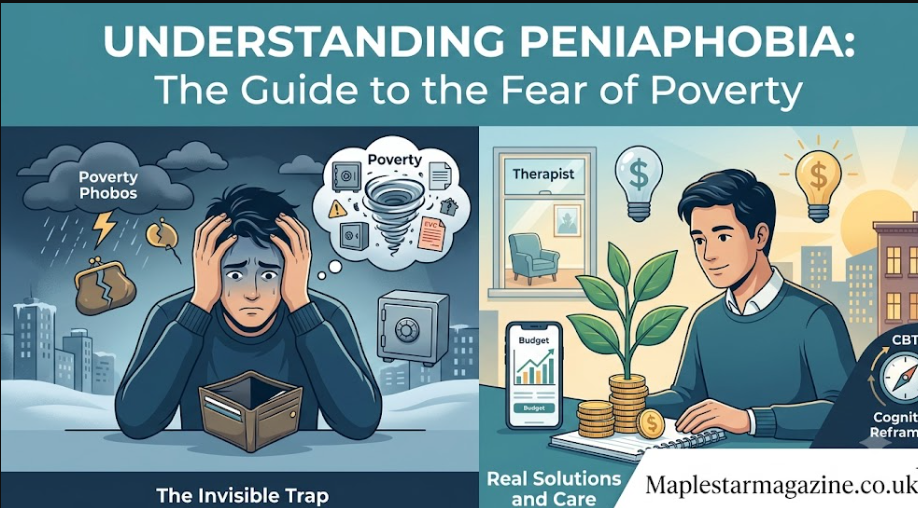
About 12.5% of US adults will deal with a specific phobia at some point in their life, according to the National Institute of Mental Health, and one of the least discussed versions of it has nothing to do with heights, spiders, or flying. Peniaphobia is the irrational, persistent fear of poverty, and it can grip someone just as tightly whether their bank account is empty or genuinely secure.
This guide from our lifestyle desk explains what peniaphobia actually is, how it differs from ordinary money stress, what drives it, and the real, evidence-based steps that help.
Table of Contents
What Does Peniaphobia Mean? A Quick Definition
Peniaphobia is the excessive, irrational fear of poverty or financial ruin, a fear that persists even when someone’s actual finances are stable. The word comes from the Greek penia, meaning poverty, and phobos, meaning fear. Unlike ordinary financial caution, this fear does not ease when circumstances improve.
It is worth being direct about something most articles on this topic skip: peniaphobia is not an official diagnosis. It does not appear by name in the DSM-5, the manual clinicians in the US use to diagnose mental health conditions. It is a descriptive, informal term, though the fear it describes fits within the DSM-5’s broader specific phobia category.
Is This a Recognized Medical Diagnosis?
No, not by name. The DSM-5 recognizes five official specific phobia subtypes: animal, natural environment, blood-injection-injury, situational, and other. A severe, persistent fear of poverty would most likely be classified under the other type rather than as its own standalone diagnosis. That distinction matters because it means a clinician would evaluate the fear using standard specific phobia criteria rather than a peniaphobia-specific checklist.
Common Signs and Symptoms
Like most anxiety-related patterns, peniaphobia tends to show up emotionally, physically, and behaviorally at the same time, not just as a passing worry.
- Persistent dread about money that does not ease even when finances are stable
- Physical symptoms during financial stress: rapid heartbeat, sweating, nausea, or trouble sleeping
- Compulsive saving or extreme guilt around ordinary, affordable spending
- Checking bank balances multiple times a day
- Overworking well beyond what current finances require
- Avoiding financial conversations, statements, or planning entirely out of dread
What Causes This Fear?
There is no single cause. Most people who experience this fear point to some combination of the following.
- A childhood shaped by real financial instability or witnessing a parent’s money struggles
- A specific traumatic event, such as a job loss, eviction, or repossession
- Inherited fear, absorbed from a parent or caregiver’s own anxious relationship with money
- Cultural or family messaging that ties self-worth directly to financial success
- Chronic exposure to economic uncertainty, rising costs, or constant social comparison online
Peniaphobia vs. Normal Financial Anxiety
Most people feel some anxiety about money, and that is normal, even useful. This fear is different in both intensity and persistence. It does not respond proportionately to actual financial risk, and it does not fade once a person’s situation genuinely improves.
How This Fear Is Treated
Because peniaphobia fits within the specific phobia category, the same first-line treatments apply: cognitive behavioral therapy and exposure-based approaches. CBT focuses on identifying the catastrophic financial predictions driving the fear and testing them against real evidence, while exposure work gradually reduces avoidance of financial tasks like checking statements or building a budget.
Fear of Poverty and Modern Economic Pressure
This fear is not evenly distributed across generations. Rising living costs, unstable job markets, and constant visibility into other people’s finances through social media have intensified financial anxiety broadly, and younger adults report some of the sharpest increases. A feed full of curated wealth and luxury lifestyle content creates a comparison trap that previous generations simply did not face at the same scale, and that comparison feeds directly into the same catastrophic thinking patterns that drive this fear.
None of this means economic conditions alone explain why one person develops a persistent, disproportionate fear while another with a similar financial picture does not. Environment raises the baseline level of financial stress everyone carries. Individual history, particularly early experience with money, still determines who crosses from ordinary stress into something more persistent and harder to shake.
A Real Example: Where This Fear Often Starts
A common pattern therapists describe involves someone who grew up in a household where a parent lost a job or a family narrowly avoided losing their home. Decades later, that person may hold a stable, well-paying job and still feel a jolt of panic every time an unexpected bill arrives, still track every dollar with a level of vigilance their actual finances do not require, and still feel a quiet sense that security could disappear at any moment. The financial danger from childhood is long gone, but the nervous system’s response to it never fully updated.
What makes this pattern hard to spot from the outside is that it often looks like discipline rather than fear. A person who never relaxes about money, who over-saves and under-spends even when they can genuinely afford otherwise, tends to get praised for financial responsibility rather than recognized as someone carrying an old fear that never got resolved. The behavior looks identical to prudence on the surface. The internal experience driving it is closer to dread.
Peniaphobia vs. Everyday Money Stress: Quick Comparison
| Factor | Everyday Money Stress | Peniaphobia |
| Responds to actual finances improving | Yes, eases with stability | No, persists regardless |
| Physical symptoms (panic, nausea, insomnia) | Rare, situational | Common, recurring |
| Duration | Comes and goes with real events | Persistent, often 6+ months |
| Impact on daily decisions | Minor adjustments | Significant avoidance or compulsive behavior |
| Best next step | Budgeting tools, financial planning | Licensed therapist, CBT-based support |
Managing anxious thought patterns takes practice beyond money specifically. Our guide on improving focus and concentration naturally covers habits that help quiet a racing, catastrophizing mind, whether the trigger is financial or something else entirely.
Analysis and Insights
The counterintuitive insight in the research on financial fear is that it correlates weakly with actual bank balance. People with substantial savings report feeling just as financially unsafe as people living paycheck to paycheck, because the fear is rarely about the numbers themselves. In therapeutic work, peniaphobia frequently traces back to a core belief formed early in life: that financial failure equals personal failure, that being poor would mean being unworthy of care or respect. That belief operates quietly, showing up as guilt after an ordinary purchase or disproportionate dread over a minor unexpected expense, long after the original financial threat has passed. Understanding that the fear is really about self-worth, not spreadsheets, is often the turning point in treatment, and it is also the detail most surface-level articles about peniaphobia leave out entirely.
One honest limitation: because this term is not a formal diagnosis, there is no standardized screening tool or prevalence data specific to it, unlike well-studied phobias such as social anxiety or agoraphobia. Everything in this guide describes a recognizable pattern, not a checklist for self-diagnosis. If this fear is disrupting your daily life, a licensed mental health professional, not an online article, is the right place to get an actual evaluation. Reading about a pattern and recognizing pieces of yourself in it is a reasonable first step, but it is genuinely just a first step, not a conclusion.
Practical Steps for Managing Financial Fear
1. Separate the Practical Task From the Emotional Reaction
Checking a bank balance and feeling panic about checking a bank balance are two different things. Naming the difference out loud, even just to yourself, starts to loosen the automatic fear response, and over time it becomes easier to complete the practical task without the emotional spike attached to it.
2. Track the Pattern, Not Just the Feeling
Note when the fear spikes: after checking an account, seeing a bill, or scrolling social media. A clear pattern makes the trigger easier to work with than a vague sense of constant dread.
3. Test Catastrophic Predictions Against Real Evidence
When the fear says “this will ruin everything,” write down what actually, concretely would happen next. Most catastrophic financial predictions do not survive being spelled out in specific, realistic steps, and seeing the gap between the imagined outcome and the realistic one on paper is often more convincing than simply trying to talk yourself out of the fear in the moment.
4. Limit Financial Doomscrolling
Constant exposure to economic bad news and curated wealth on social media measurably worsens financial anxiety for many people. A simple time limit on financial news and social feeds is a low-effort, high-impact change.
5. Build a Concrete Worst-Case Plan
Vague fear thrives on uncertainty. Writing an actual, specific plan for a genuine worst-case scenario, emergency savings, a support network, next steps, often reduces the fear’s intensity more than avoiding the thought altogether. The goal is not to dwell on disaster. It is to take the disaster out of the realm of the unknown, where fear tends to grow unchecked, and put it somewhere concrete enough to actually plan around.
6. Talk to a Licensed Therapist If the Fear Persists
If financial fear has lasted six months or more and is affecting daily decisions, relationships, or sleep, a therapist trained in CBT or exposure-based approaches is the most direct, evidence-based path to relief. This is not a last resort. It is the actual first-line treatment, and starting there tends to produce faster, more lasting results than months of trying to manage the fear alone through willpower or avoidance.
Frequently Asked Questions
| Q: What does peniaphobia mean? A: Peniaphobia means an excessive, irrational fear of poverty or financial ruin. It comes from the Greek words penia, meaning poverty, and phobos, meaning fear, and it persists even when a person’s actual finances are stable. |
| Q: Is peniaphobia a real diagnosis? A: Not by name. Peniaphobia does not appear in the DSM-5, but a severe, persistent fear of poverty would generally be evaluated using the manual’s broader specific phobia criteria, under its “other” subtype. |
| Q: What are the symptoms of peniaphobia? A: Common symptoms include persistent dread about money regardless of actual finances, physical anxiety symptoms like rapid heartbeat or insomnia, compulsive saving, guilt over ordinary spending, and constantly checking bank balances. |
| Q: What causes fear of poverty? A: It commonly develops from childhood financial instability, a specific traumatic event like job loss or eviction, an inherited fear from a parent, or chronic exposure to economic uncertainty and social comparison. |
| Q: How is peniaphobia treated? A: Cognitive behavioral therapy and exposure-based approaches are the primary evidence-based treatments, since this fear falls within the broader category of specific phobias, which respond well to these methods. |
| Q: Is peniaphobia the same as being frugal or careful with money? A: No. Practical budgeting and caution respond to actual financial circumstances and ease when things improve. This fear is disproportionate to real financial risk and persists regardless of actual stability. |
| Q: When should I see a professional about financial anxiety? A: If the fear has lasted six months or longer and is affecting your sleep, relationships, or daily decisions, a licensed therapist experienced in anxiety disorders is the appropriate next step, not a symptom checklist online. |
Conclusion
Peniaphobia describes a real, recognizable pattern: an intense fear of poverty that does not respond to actual financial stability, often rooted in early experience rather than current circumstances. Understanding the pattern is useful. Treating it, when it is genuinely disrupting daily life, is a job for a licensed professional rather than a self-help checklist.
- Peniaphobia is not an official DSM-5 diagnosis, but fits within the broader specific phobia category
- It is defined by persistence and disproportion, not by an actual bank balance
- Common roots include childhood financial instability, inherited fear, and chronic economic uncertainty
- CBT and exposure-based therapy are the evidence-based, first-line treatments
- A fear lasting six months or more that disrupts daily life is worth bringing to a licensed therapist
Does any of this pattern sound familiar, in yourself or someone you know? Share your experience in the comments, and if this resonates strongly, consider reaching out to a licensed therapist rather than carrying it alone.

The Maple Star Magazine editorial team is responsible for the accuracy, structure, and publishing standards that every article on this site is held to. This includes verifying sources before publication, maintaining consistency across our Travel, Technology, Lifestyle and revisiting published guides as facts, pricing, or industry standards change. Content published under this byline reflects collaborative editorial work rather than a single author's individual reporting.