










Search this exact question and you will find confident, contradictory answers on the very same reference sites. One page says carbon monoxide reliably rises. Another says it does neither. The honest answer matters more than most trivia questions, since it directly affects where you place a device meant to save your life. Here is what the actual physics says, why the confusion exists in the first place and what it means for your home, based on official fire safety guidance rather than a guess.
Table of Contents
The Short Answer
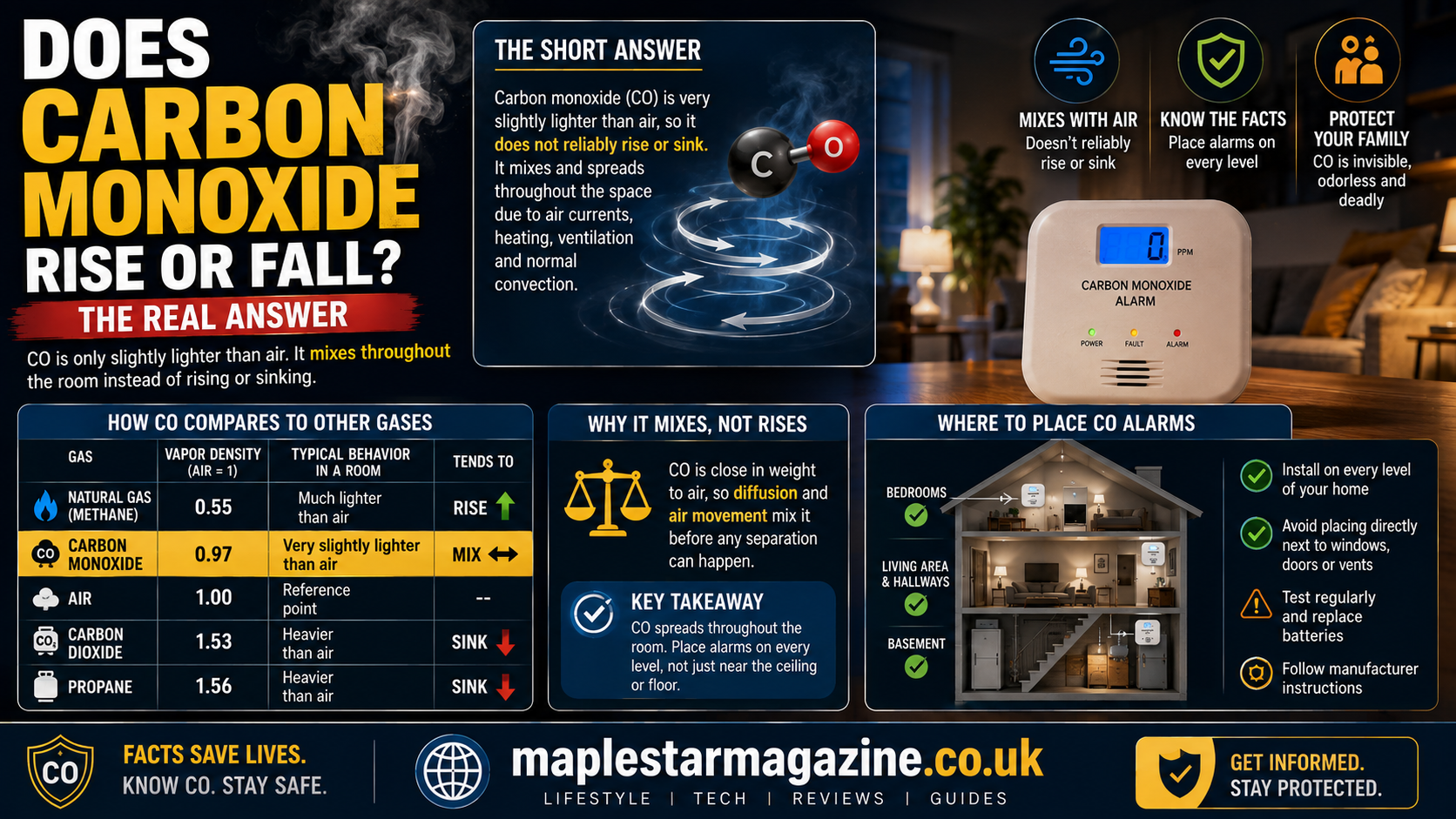
Carbon monoxide is only very slightly lighter than air, close enough that it does not reliably rise or sink in a room the way genuinely light or heavy gases do. Instead, it mixes and diffuses throughout the space, driven far more by air currents, heating and cooling systems and normal convection than by its own weight. That is precisely why fire safety codes do not require carbon monoxide alarms to be mounted at any specific height the way some other gas detectors are.
Why This Question Gets Asked So Often
The confusion makes sense once you consider the gases most people already know something about. Natural gas is genuinely lighter than air and does tend to rise, which is why detectors for it typically go near the ceiling. Propane is genuinely heavier than air and tends to sink, which is why propane detectors typically go near the floor. Carbon monoxide sits in an entirely different category, close enough to air’s own weight that neither rule applies. That nuance rarely survives when people apply the same “rises or sinks” logic to every gas by habit.
The Science: Comparing CO’s Weight to Air
Carbon monoxide has a molecular weight of approximately 28.01 grams per mole. Ordinary air, a mix of roughly 78 percent nitrogen and 21 percent oxygen, has an average molecular weight of approximately 28.97 grams per mole. Vapor density, a standard safety measure that compares a gas to air using a value of 1 for air itself, puts carbon monoxide at roughly 0.97. A value under 1 technically means a gas is lighter than air. A value this close to 1 means the difference is functionally negligible for how the gas behaves in a real room.
How CO’s weight compares to other common gases
| Gas | Vapor density (air = 1) | Typical behavior in a room |
| Natural gas (methane) | About 0.55 | Rises noticeably, tends to collect near ceilings |
| Carbon monoxide | About 0.97 | Mixes evenly, does not reliably rise or sink |
| Air | 1.00 | Reference point |
| Carbon dioxide | About 1.53 | Sinks noticeably, tends to collect near floors |
| Propane | About 1.56 | Sinks noticeably, tends to collect near floors |
Why “Slightly Lighter” Does Not Mean It Rises
A gas needs a meaningfully different density from air to reliably stratify by height in a room. Carbon monoxide simply does not have one. Natural gas at a vapor density near 0.55 is roughly half the weight of air, a difference large enough to produce real, predictable buoyancy. Carbon monoxide at 0.97 is close enough to air’s own weight that ordinary diffusion, the natural tendency of gas molecules to spread out and mix regardless of small weight differences, dominates its behavior instead.
A U.S. Patent and Trademark Office technical filing on gas detector design makes this point directly: it describes the popular belief that lighter gases “float atop” heavier ones in a room as a misconception, explaining that diffusion and normal air movement mix gases together well before any meaningful separation by density could occur. How Gas Detectors Actually Work Inside Your Home.
That same filing makes a broader point worth understanding on its own: even if a heavier gas were introduced low in a room in a way that minimized initial mixing, ordinary diffusion and convection would still blend it with the surrounding air over time. Gases do not behave like oil and water, staying neatly separated by density indefinitely. The popular image of a dense, invisible gas pooling at floor level like water in a bathtub is a reasonable mental model for something like carbon dioxide fire suppression in an industrial setting. It does not describe how carbon monoxide behaves in an ordinary, lived-in home with normal air movement.
The Role of Heat in Why CO Can Seem to Rise
Here is where a lot of the confusion actually comes from. It has nothing to do with carbon monoxide’s own weight. Carbon monoxide is produced by combustion, a burning furnace, a car engine or a gas stove. Combustion also produces heat along with the gas. Hot air is less dense than cool air regardless of what gas it carries, so CO-laden air can rise immediately after it is produced simply because it is warm, the same reason smoke rises from a fire.
That thermal lift fades quickly. As the CO-laden air cools to match the room’s ambient temperature, it loses the buoyancy that was carrying it upward. Its behavior then reverts to ordinary diffusion. This is the detail most competing explanations skip. It is the real reason CO sometimes appears to rise right at its source even though the gas itself is not meaningfully lighter than air. A carbon monoxide detector mounted directly above a furnace or water heater may pick up a leak faster precisely because of this initial thermal plume, not because carbon monoxide itself has any strong inherent tendency to travel upward once it has cooled to room temperature.
How CO Actually Behaves in a Room
Once CO cools to room temperature, three forces dominate where it ends up: diffusion, convection currents from heating and cooling systems and ordinary air movement from doors, windows and foot traffic. All three work in the same direction, spreading the gas throughout the available space rather than concentrating it near the floor or ceiling. In a sealed, perfectly still room with no air movement at all, an extremely slow, weak density-based separation could theoretically occur over a long period. Real homes are never that still.
That is also why carbon monoxide is so dangerous in the first place. A gas that reliably rose or sank would be easier to detect by instinct or smell alone. Carbon monoxide is odorless, colorless and tasteless. Now you know it also does not obligingly collect in one predictable spot, which is exactly why a dedicated alarm matters more than any rule of thumb about gas behavior.
Where You Should Actually Put a CO Detector
According to the U.S. Consumer Product Safety Commission’s own Carbon Monoxide Information Center, alarms should be installed according to the manufacturer’s instructions. At least one CO alarm should be placed on every level of the home, including the basement, plus one outside each separate sleeping area. Because CO mixes so thoroughly with room air, CPSC guidance explicitly notes that alarms can be installed in a plug-in receptacle or high on a wall, since CO from any source becomes well mixed with the air in the house regardless of where the detector sits.
NFPA 72, the national fire alarm and signaling code that also governs carbon monoxide detection, does not mandate a specific mounting height for the same reason. Instead, it directs installers to evaluate potential CO sources, airflow patterns and mechanical influences for each specific room rather than following a blanket height rule. In practice, that means following the manufacturer’s installation instructions matters far more than guessing at height based on whether CO “should” rise or sink.
Common CO Myths That Could Put You at Risk
The most persistent myth is treating carbon monoxide like natural gas or propane and assuming a detector only works if mounted near the ceiling or floor. A second common myth is assuming an open window clears CO quickly enough to make an alarm unnecessary, when in reality ventilation speed depends heavily on outdoor conditions, window placement and how much CO is actively being produced. A third is assuming a working smoke detector also covers carbon monoxide, when the two require entirely different sensor technology and a combination unit must be explicitly rated for both.
A fourth myth worth addressing directly: some people assume that because CO is “only slightly” lighter than air, it must at least settle somewhere predictable given enough time, so a detector placed anywhere in a room will eventually catch it regardless of timing. In practice, a slow, weak, theoretical settling process is far too gradual to matter during an actual leak, where CO concentrations can climb from safe to dangerous within minutes depending on the source. Waiting on physics to sort itself out is not a safety strategy; a properly placed, working alarm is.
A fifth myth is believing that a CO alarm which has not gone off means the air is safe. Alarms are calibrated to sound before concentrations reach levels considered immediately dangerous, which means low-level, chronic exposure from a small ongoing leak can still cause headaches, fatigue and nausea without ever triggering a full alarm. Anyone experiencing unexplained flu-like symptoms that improve when they leave the house and return when they come back should treat that pattern seriously, alarm or no alarm. Have fuel-burning appliances inspected promptly if that pattern shows up.
Where Carbon Monoxide Actually Comes From in a Home
According to CPSC, carbon monoxide is produced by the incomplete burning of fuels including coal, wood, charcoal, oil, kerosene, propane and natural gas, along with equipment powered by internal combustion engines such as portable generators, cars, lawn mowers and power washers. On average, roughly 170 people in the United States die every year from CO produced specifically by non-automotive consumer products such as malfunctioning furnaces, water heaters and room heaters. Attached garages, poorly ventilated rooms with fuel-burning appliances and portable generators run too close to a home are among the most common real-world sources behind those deaths.
Seasonal patterns matter too. CO poisoning incidents spike noticeably during winter months and immediately after severe storms, when portable generators come out during power outages and furnaces run for extended stretches without their usual off-season inspection. A furnace or water heater that has gone a year or more without professional servicing is far more likely to develop the kind of incomplete combustion that produces dangerous CO levels, which is why CPSC specifically recommends an annual inspection of all fuel-burning appliances rather than waiting for a visible problem to appear. Chimneys and flues blocked by debris, nesting animals or ice buildup are another frequently overlooked source, since a blockage can force combustion byproducts back into a living space instead of venting them outside as designed.
Frequently Asked Questions
Is carbon monoxide heavier or lighter than air?
Carbon monoxide is very slightly lighter than air, with a vapor density of about 0.97 compared to air’s reference value of 1. That difference is too small to make CO reliably rise the way genuinely light gases like natural gas do.
Does carbon monoxide sink to the floor?
No. Carbon monoxide does not reliably sink either, since its weight is too close to that of ordinary air. It mixes and disperses throughout a room rather than settling at any particular height.
Where should you not put a carbon monoxide detector?
Avoid placing a CO detector too close to fuel-burning appliances, near windows, doors or vents where drafts could skew readings. Also avoid behind furniture or curtains that could block airflow to the sensor. Beyond those specific spots, height is far less important than manufacturer instructions and proximity to sleeping areas.
How fast does carbon monoxide spread in a room?
Carbon monoxide spreads relatively quickly once released, driven by diffusion, HVAC airflow and normal air movement rather than settling slowly by weight. Exact speed depends on ventilation, room size and how much CO is being produced, which is part of why continuous monitoring matters more than periodic checking.
Can carbon monoxide detectors be too low?
Generally no, as long as the detector is not placed directly on the floor where dust or debris could interfere with the sensor. It should also avoid any spot the manufacturer specifically advises against. CPSC guidance confirms that plug-in units placed at outlet height are effective precisely because CO mixes evenly with room air.
Does opening a window clear carbon monoxide?
Ventilation helps dilute carbon monoxide. It is not a substitute for identifying and fixing the source or for having a working alarm. How quickly a window clears CO depends heavily on outdoor wind conditions, window size and how much CO is actively being generated.
Final Thoughts
Does carbon monoxide rise or fall? Neither, reliably. That single fact is more useful for your safety than either wrong answer would be. CO’s weight is close enough to air’s that diffusion, airflow and heating systems determine where it ends up far more than gravity does, which is exactly why official guidance skips height rules and focuses on manufacturer instructions, proximity to sleeping areas and coverage on every level of the home instead. Check your own home against that standard today. Make sure every alarm is tested and within its expiration window.

The Maple Star Magazine editorial team is responsible for the accuracy, structure, and publishing standards that every article on this site is held to. This includes verifying sources before publication, maintaining consistency across our Travel, Technology, Lifestyle and revisiting published guides as facts, pricing, or industry standards change. Content published under this byline reflects collaborative editorial work rather than a single author's individual reporting.