









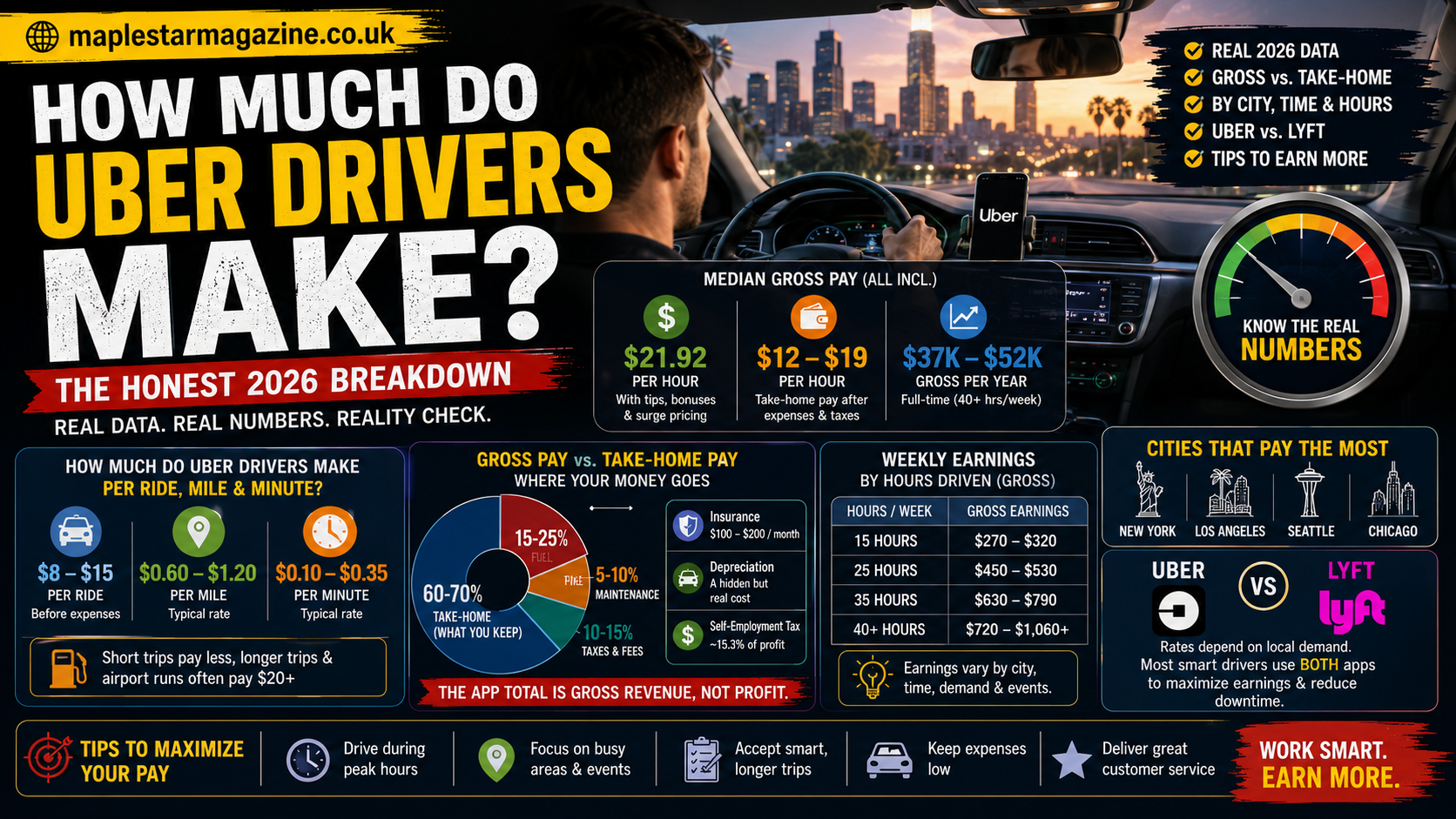
The number shown in the Uber driver app is not your paycheck. It is gross revenue, and the gap between that number and what actually lands in your bank account after gas, wear, and taxes surprises almost every new driver. How much do Uber drivers make? Based on real trip data from tens of thousands of tracked drivers, the honest answer sits well below the eye-catching numbers some sign-up pages advertise.
This guide from our lifestyle desk breaks down real 2026 gross and take-home pay, how earnings vary by city and time, and how Uber stacks up against Lyft.
Table of Contents
How Much Do Uber Drivers Make? The Quick Answer
Uber drivers earn a median of $21.18 per hour in gross trip pay, rising to about $21.92 per hour once tips, bonuses, and surge pricing are included, according to Gridwise, based on real earnings data from 66,952 tracked drivers. After fuel, maintenance, depreciation, and self-employment tax, take-home pay commonly falls to $12 to $19 per hour.
Self-reported salary sites sometimes list far higher averages, since they rely on voluntary submissions that tend to skew toward more successful drivers. Real, continuously tracked trip data is the more reliable source for what a typical driver actually earns.
So how much do Uber drivers make in practice, once you account for where they drive and when? The honest answer is a range, not a single number, and that range is wide enough that two drivers working the same number of hours in the same city can end up with meaningfully different paychecks based on nothing more than timing and route choice.
How Much Do Uber Drivers Make Per Ride, Mile, and Minute
Most UberX rides pay the driver somewhere between $8 and $15 before expenses, combining a per-mile rate, typically 60 cents to $1.20, with a per-minute rate, typically 10 to 35 cents, plus any surge multiplier. Short trips under 5 miles often pay closer to the low end, while longer trips and airport runs push well past $20.
Breaking the question down this way, per ride rather than per hour, is often more useful for a driver deciding in real time whether to accept a specific trip request. A driver who understands roughly how much Uber drivers make on a 3-mile trip versus a 15-mile trip can make faster, more profitable accept-or-decline decisions during a shift than one relying purely on gut feeling.
Gross Pay vs. Take-Home Pay: Why the Gap Is So Big
The app total is gross revenue, not profit. Fuel typically consumes 15 to 25 percent of gross pay, maintenance another 5 to 10 percent, and rideshare-specific insurance runs $100 to $200 a month on top of a driver’s regular policy. Vehicle depreciation is the cost most new drivers forget entirely, since it does not show up as a weekly expense the way gas does. This single gap, between what the app shows and what a driver actually keeps, is the most common reason people are disappointed by how much Uber drivers make once they run their own numbers after a few months on the road.
How Much Do Uber Drivers Make in a Week or Month?
A driver working 25 hours a week at the national median grosses roughly $450 to $530 before expenses, or about $1,800 to $2,100 a month. Full-time drivers logging 40-plus hours a week typically gross $37,000 to $52,000 annually, with net take-home pay commonly landing between $25,000 and $38,000 after all costs and self-employment tax.
These figures assume relatively steady demand throughout the week. In practice, how much Uber drivers make in any given week swings noticeably based on local events, weather, and even which days fall on a weekend, which is part of why many full-time drivers track their earnings week to week rather than expecting a flat, predictable paycheck.
Which Cities Pay Uber Drivers the Most?
New York City stands apart from every other US market: the NYC Taxi and Limousine Commission sets a legally guaranteed minimum driver pay rate for high-volume rideshare services. As of March 2026, that floor is $1.283 per mile plus $0.681 per minute for standard trips. No other major US city has an equivalent legal wage floor for rideshare drivers, which is a large part of why NYC, Los Angeles, Seattle, and Chicago consistently report some of the highest average hourly earnings in the country.
Outside of New York, how much Uber drivers make in any given city is set entirely by supply, demand, and local pricing algorithms rather than any legal floor. A driver in a smaller market with less competition and steady local demand can sometimes out-earn a driver in a larger, more expensive city simply because fewer drivers are splitting the same ride requests.
Uber vs. Lyft: Which Pays More?
Neither platform consistently outpays the other nationally. Rates depend heavily on local demand, and many experienced drivers run both apps simultaneously, accepting whichever ride request comes first, rather than committing to a single platform.
Running both apps at once is less about which company pays better on average and more about reducing idle time between rides. A driver who only accepts Uber requests spends more unpaid minutes waiting than one willing to take the next available ride from either platform, and that reduction in dead time often affects real hourly earnings more than any difference in the two companies’ base rates.
A Real Example: Two Drivers, Same City, Different Take-Home Pay
Picture two drivers in the same mid-size city, both grossing $25 an hour. The first drives a paid-off, fuel-efficient sedan and tracks every business mile for the tax deduction. The second drives a financed SUV with a $500 monthly payment and never logs mileage. Both see the identical number in the Uber app at the end of the week. Only one of them is actually taking home a livable hourly rate once the vehicle costs and missed tax deduction are accounted for, and the gap between the two is entirely invisible until someone actually runs the math.
Multiply that gap across a full year of driving and the difference stops being a rounding error. The driver who tracks mileage and drives an economical vehicle can end up keeping several thousand dollars more of the exact same gross earnings than the driver who does neither, without driving a single additional hour. That is the clearest illustration of why the question of how much Uber drivers make cannot be answered with one number alone.
Weekly Earnings by Hours Driven
| Hours per Week | Gross Pay (at $21 median) | Estimated Net Pay (after expenses) |
| 15 hours (part-time) | ~$315 | ~$210–$285 |
| 25 hours | ~$525 | ~$350–$475 |
| 40 hours (full-time) | ~$840 | ~$560–$760 |
| 55+ hours | ~$1,155+ | ~$770–$1,045+ |
Treating rideshare income like any other income stream benefits from the same discipline. Our guide on work from home productivity tips covers structuring flexible, self-directed schedules, a skill that transfers directly to planning your driving hours around peak demand.
Analysis and Insights
The counterintuitive insight is that the driver making the least visible effort to track expenses is often the one earning the least in real terms, even while grossing the same as everyone else. How much do Uber drivers make is really two separate questions: what does the app show, and what actually survives contact with fuel prices, tire wear, insurance premiums, and a 15.3 percent self-employment tax bill. Drivers who log every business mile at the current IRS rate, 76 cents per mile as of mid-2026, following a rare mid-year adjustment, can turn a five-figure deduction into thousands of dollars in real tax savings that never show up in the weekly earnings summary at all.
One honest limitation: every figure in this guide is a national or platform-wide estimate. Your actual pay depends heavily on your specific city, vehicle, the hours you choose to drive, and how consistently you claim mileage on your taxes, so treat these numbers as a planning baseline rather than a guarantee.
Practical Recommendations for Maximizing Your Pay
1. Track Every Business Mile From Day One
At the current IRS rate of 76 cents per mile, a driver logging 25,000 business miles a year is sitting on an $19,000 deduction. A simple mileage app run in the background costs far less than the tax savings it produces.
2. Calculate Your Real Hourly Rate, Not Just Gross Pay
Subtract fuel, a reasonable maintenance estimate, and insurance from your weekly gross, then divide by hours worked. That number, not the one in the app, is what actually determines whether driving is worth your time, and it is the only honest answer to how much Uber drivers make in your specific situation.
3. Choose a Fuel-Efficient, Paid-Off Vehicle If Possible
A financed SUV can quietly erase $5 to $12 an hour in apparent earnings once payments and fuel costs are factored in, compared to an economical, owned vehicle doing the same trips.
4. Drive During Genuine Peak Demand, Not Just Long Hours
Airport rushes, weekend nights, and local event end times consistently pay more per hour than simply logging more total hours online during slow periods.
5. Minimize Deadhead Miles Between Rides
Unpaid miles driving to pick up your next passenger still cost fuel and add wear. Positioning near likely pickup zones instead of driving randomly reduces this hidden cost.
6. Know Your City’s Specific Pay Rules
If you drive in New York City, the legally guaranteed per-mile and per-minute minimum applies to you directly. Elsewhere, no such floor exists, which makes tracking your own real numbers even more important.
Frequently Asked Questions
These are the questions we hear most often from people trying to figure out how much Uber drivers make before committing real time behind the wheel.
| Q: How much do Uber drivers make per hour? A: Uber drivers earn a median of about $21 per hour in gross trip pay, based on real tracked driver data. After expenses like fuel, maintenance, and taxes, take-home pay typically falls to $12 to $19 per hour. |
| Q: How much do Uber drivers make per mile? A: UberX drivers typically earn 60 cents to $1.20 per mile, plus a separate per-minute rate, though this varies by city and surge conditions. |
| Q: How much do Uber drivers make a week? A: A driver working 25 hours a week at the national median gross rate earns roughly $450 to $530 before expenses, or noticeably less after fuel, maintenance, and taxes are subtracted. |
| Q: Is driving for Uber actually worth it financially? A: It depends heavily on your vehicle costs, the hours and location you drive, and whether you claim mileage deductions. Drivers with fuel-efficient, paid-off vehicles who track expenses carefully tend to see meaningfully better real returns than those who do not. |
| Q: Do Uber drivers make more money than Lyft drivers? A: Neither platform consistently pays more nationally. Earnings depend on local demand, and many experienced drivers run both apps at once to maximize ride offers. |
| Q: Which US city pays Uber drivers the most? A: New York City has the only legally guaranteed minimum rideshare pay rate in the country, currently $1.283 per mile plus $0.681 per minute, which contributes to some of the highest average earnings nationally. |
| Q: Can Uber drivers deduct mileage on their taxes? A: Yes. Uber drivers are independent contractors and can deduct business mileage at the current IRS standard rate, 76 cents per mile as of mid-2026, which can substantially reduce taxable income. |
| Q: How much do Uber drivers make compared to a regular part-time job? A: At the national median, gross pay is competitive with many part-time jobs, but after vehicle expenses and self-employment tax, real take-home pay for Uber drivers often lands lower than a traditional part-time role paying a similar hourly wage on paper. |
Conclusion
How much do Uber drivers make comes down to two very different numbers: a gross figure near $21 an hour that looks appealing on paper, and a real take-home figure, often $12 to $19 an hour, that only becomes clear once fuel, vehicle wear, and taxes are actually subtracted. Anyone seriously weighing how much Uber drivers make against their own time should run both numbers before deciding, not just the one the app shows first.
- Median gross pay sits around $21 per hour, based on real tracked driver data
- Take-home pay after expenses commonly falls to $12 to $19 per hour
- New York City is the only major US market with a legally guaranteed rideshare pay floor
- Tracking business mileage at the current 76-cent IRS rate meaningfully improves real take-home pay
- Vehicle choice affects true hourly earnings as much as the city or hours you drive
Are you driving for extra income already, or weighing whether to start? Tell us in the comments what your real numbers have looked like.

The Maple Star Magazine editorial team is responsible for the accuracy, structure, and publishing standards that every article on this site is held to. This includes verifying sources before publication, maintaining consistency across our Travel, Technology, Lifestyle and revisiting published guides as facts, pricing, or industry standards change. Content published under this byline reflects collaborative editorial work rather than a single author's individual reporting.