








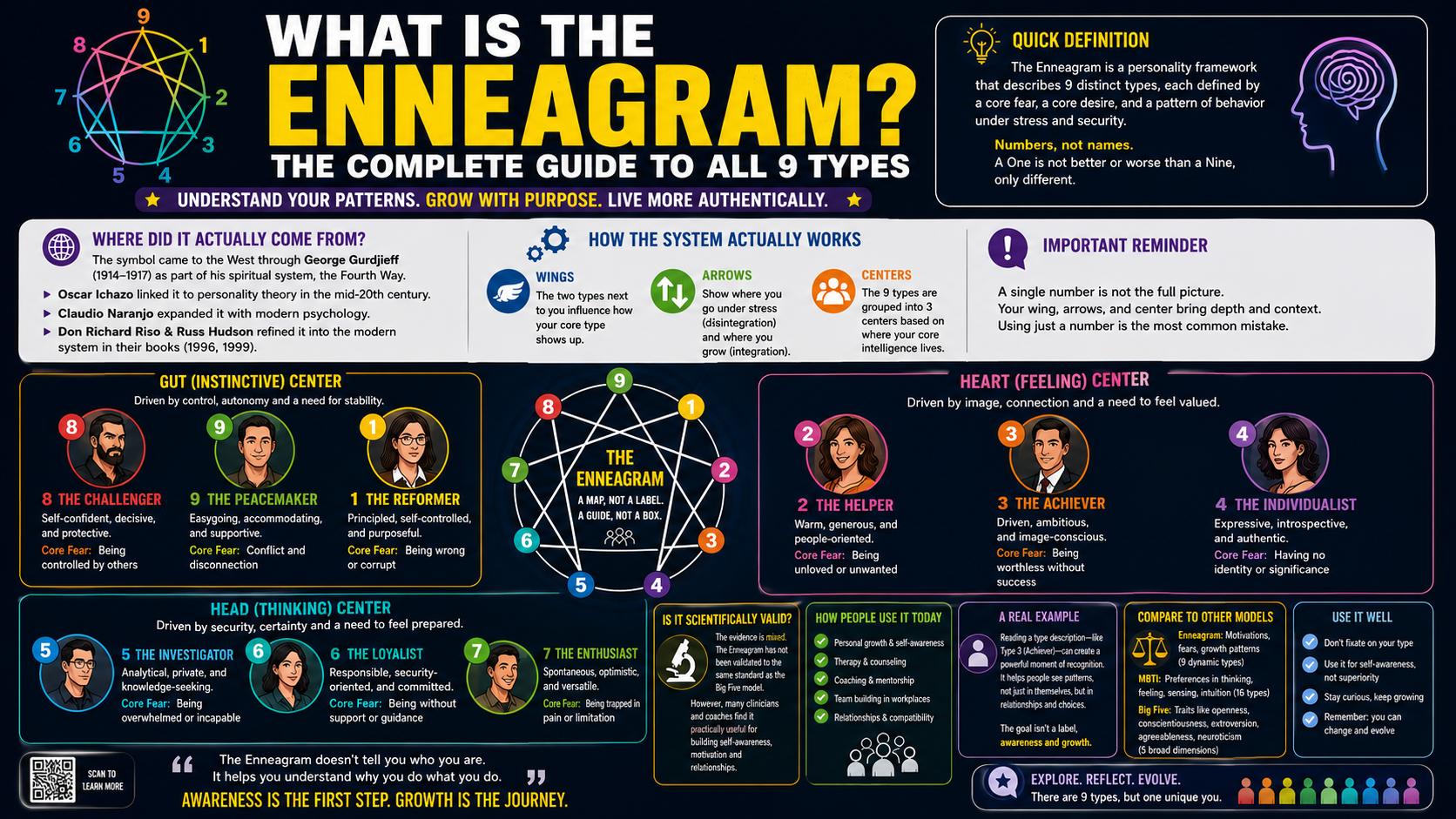
Despite its ancient-looking nine-pointed symbol, the personality system built around it is barely 70 years old, not a relic of forgotten wisdom. The Enneagram sorts personality into nine core types, each built around a specific fear and desire, and it has quietly become one of the most requested self-discovery tools in therapy offices, corporate workshops, and dating app bios alike.
This guide from our lifestyle desk explains where the Enneagram actually came from, how the system works, all nine types in plain language, and an honest look at what the science does and does not support.
Table of Contents
What Is the Enneagram? A Quick Definition
The Enneagram is a personality framework that describes nine distinct types, each defined by a core fear, a core desire, and a predictable pattern of behavior under stress and security. Numbers, not names, label each type specifically because numbers carry no built-in judgment: a One is not better or worse than a Nine, only different.
The system takes its name from the nine-pointed geometric figure used to map the types and the lines connecting them, ennea being Greek for nine and gramma for something written or drawn.
Where Did It Actually Come From?
The nine-pointed symbol entered modern use through George Gurdjieff, an Armenian-Greek teacher who introduced it to private students in Moscow and St. Petersburg between 1914 and 1917 as part of a broader spiritual framework he called the Fourth Way. Gurdjieff’s diagram had no personality types attached to it yet.
Oscar Ichazo, a Bolivian philosopher, connected the symbol to personality theory in the mid-20th century, and Claudio Naranjo, a Chilean psychiatrist, expanded and refined the framework by blending it with contemporary psychology. The version most people encounter today owes much of its structure to Don Richard Riso and Russ Hudson, whose 1996 book Personality Types and 1999 follow-up The Wisdom of the System added levels of development, wings, and the integration and stress arrows that define the modern system.
How the System Actually Works
Three structural pieces make up the full system. Wings are the two types adjacent to your core type on the diagram, which color and season your dominant type’s traits. Arrows of integration and disintegration show which type’s traits you tend to pick up under stress versus during genuine growth. Centers group the nine types into three triads based on where each type’s core intelligence sits: gut, heart, or head.
None of these pieces work as a standalone label. A Type 4 with a strong 5-wing behaves noticeably differently from a Type 4 with a strong 3-wing, even though both share the same core fear of having no real identity. Reducing anyone to a single number, without the wing, the arrows, or the center it belongs to, is the single most common way people misuse the system and then dismiss it as inaccurate.
The 9 Types, Grouped by Center
Grouping the nine types by center, rather than listing them in flat numerical order, makes the underlying logic of the system easier to follow.
Gut or Instinctive Center (Types 8, 9, 1): driven by control, autonomy, and a need for stability.
- Type 8, The Challenger: self-confident, decisive, and protective, with a core fear of being controlled by others
- Type 9, The Peacemaker: easygoing and accommodating, with a core fear of conflict and disconnection
- Type 1, The Reformer: principled and self-controlled, with a core fear of being wrong or corrupt
Heart or Feeling Center (Types 2, 3, 4): driven by image, connection, and a need to feel valued.
- Type 2, The Helper: warm and generous, with a core fear of being unloved or unwanted
- Type 3, The Achiever: driven and image-conscious, with a core fear of being worthless without success
- Type 4, The Individualist: expressive and introspective, with a core fear of having no identity or significance
Head or Thinking Center (Types 5, 6, 7): driven by security, certainty, and a need to feel prepared.
- Type 5, The Investigator: analytical and private, with a core fear of being overwhelmed or incapable
- Type 6, The Loyalist: responsible and security-oriented, with a core fear of being without support or guidance
- Type 7, The Enthusiast: spontaneous and versatile, with a core fear of being trapped in pain or limitation
Is It Scientifically Valid?
Honestly, the evidence is mixed. Unlike the Big Five personality model, which rests on decades of empirical replication, the Enneagram has not been validated to the same standard by mainstream academic psychology, and its origin in spiritual and esoteric traditions rather than a research lab makes some psychologists wary. At the same time, some clinicians report genuine practical value in using it to build rapport and explore motivation in therapy, even without it functioning as a formally diagnostic tool.
How People Use It Today
Beyond personal reflection, it shows up in couples counseling, corporate team-building workshops, coaching practices, and an entire ecosystem of dating and relationship content that maps compatibility by type combination.
A Real Example: Recognizing a Pattern, Not Getting a Label
A common story among people who first encounter this framework involves reading a type description, often the Type 3 Achiever or the Type 6 Loyalist, and feeling an uncomfortable jolt of recognition rather than simple curiosity. Someone who has spent years quietly measuring their worth against their achievements might read the Achiever’s core fear, being worthless without success, and recognize a pattern they had never actually put into words before. The useful part is not the number itself. It is the language the description hands someone for a pattern they were already living but had not yet named.
What tends to happen next separates people who get lasting value from the framework from people who lose interest within a week. The ones who stick with it treat the type description as a starting question, chasing down where the fear actually came from and what it costs them day to day. The ones who lose interest treat the number as the finish line, collect it like a piece of trivia, and move on to the next quiz without ever testing the description against their own actual behavior.
Comparing It to MBTI and Big Five
| Factor | Enneagram | MBTI | Big Five |
| Focus | Core motivation, fear, and desire | Cognitive preferences | Measurable trait scores |
| Scientific validation | Limited, contested | Debated, partial | Strong, widely replicated |
| Origin | Spiritual and esoteric traditions | Jungian-inspired, mother-daughter team | Academic psychology research |
| Best used for | Self-reflection, motivation, growth | Communication style, teamwork | Research, structured trait comparison |
Turning self-awareness into an actual daily habit is the harder part. Our guide on how to stay motivated every day covers practical habits that hold up once the initial excitement of a new personality framework wears off.
Analysis and Insights
The counterintuitive insight here is that the Enneagram’s popularity has very little to do with scientific rigor and almost everything to do with narrative depth. A Big Five report tells you your Conscientiousness sits at the 75th percentile, a precise but emotionally flat data point. The Enneagram instead tells you why you overwork, what you are actually afraid of underneath it, and what that fear tends to do to your relationships under stress. That difference between a trait score and a motivational story is a large part of why it keeps spreading through therapy rooms, team offsites, and group chats, even without the empirical backing that gives frameworks like the Big Five their scientific authority.
One honest limitation: mistyping is genuinely common, especially from short online quizzes taken quickly, and the framework carries real risk of becoming a rigid label rather than a starting point for reflection. Treat any single quiz result as a hypothesis worth testing against full type descriptions, not a verdict, and be skeptical of anyone using it to make hiring decisions or diagnose a partner in an argument.
Practical Recommendations for Using It Well
1. Read Full Type Descriptions, Not Just a Quiz Result
Short online quizzes are a starting point, not a verdict. Read the complete description of your top two or three suggested types before settling on one, since core fear and motivation matter more than surface behavior.
2. Identify Your Wings for a Fuller Picture
Your two adjacent types shape how your core type actually shows up day to day. A Type 9 with an 8-wing behaves noticeably differently than a Type 9 with a 1-wing, even though both share the same core number.
3. Pay Attention to Your Stress and Growth Arrows
Notice which type’s traits you pick up when things go wrong versus when you are genuinely thriving. That movement, not just your resting type, often reveals more about your actual patterns.
4. Use It as a Conversation Starter, Not a Label
The most useful conversations about it sound like curiosity: what is this person actually afraid of, what do they need to feel secure. The least useful ones sound like a label used to end an argument.
5. Cross-Check Against Real Behavior Over Time
A type description that fit perfectly during a stressful month may not hold up during a calm one. Revisit your type after several months of paying attention to your actual patterns, not just your first impression.
6. Keep the Scientific Caveat in Mind
Enjoy the self-reflection value, but do not treat its results as clinically validated fact. It has not earned that status from mainstream academic psychology, and treating it that way sets up conclusions the framework cannot actually support.
Frequently Asked Questions
| Q: What is the Enneagram in simple terms? A: The Enneagram is a personality framework describing nine core types, each defined by a specific fear, desire, and behavior pattern under stress. It uses numbers 1 through 9 rather than names to avoid ranking one type above another. |
| Q: Where did the Enneagram come from? A: The nine-pointed symbol traces to George Gurdjieff in the early 1900s. Oscar Ichazo and Claudio Naranjo later connected it to personality theory in the mid-20th century, and Don Richard Riso and Russ Hudson expanded it into the modern system in the 1990s. |
| Q: Is the Enneagram scientifically proven? A: Not to the standard of the Big Five personality model. Mainstream academic psychology has not fully validated it, though some clinicians report practical value using it in therapy and coaching settings. |
| Q: What are the 9 Enneagram types? A: The types are: 1 The Reformer, 2 The Helper, 3 The Achiever, 4 The Individualist, 5 The Investigator, 6 The Loyalist, 7 The Enthusiast, 8 The Challenger, and 9 The Peacemaker. |
| Q: What is an Enneagram wing? A: A wing is one of the two types adjacent to your core type on the nine-pointed diagram. It adds shading and nuance to your dominant type without changing your core number. |
| Q: Is the Enneagram the same as MBTI? A: No. MBTI categorizes cognitive and communication preferences, while the Enneagram focuses on core motivation, fear, and desire. They measure different things and are not interchangeable. |
| Q: How do I find my Enneagram type? A: Start with a reputable online quiz, then read the full description of your top two or three suggested types rather than accepting the first result. Revisiting your type after a few months of self-observation often gives a more accurate picture. |
Conclusion
The Enneagram offers a genuinely useful language for understanding why people do what they do, built on nine core types, three centers, and a set of wings and arrows that add real nuance once you move past a single quiz result. It is not a scientifically validated instrument in the way the Big Five is, and it works best held that way: a tool for reflection, not a verdict.
- The Enneagram describes 9 types, each built around a specific core fear and desire
- Its nine-pointed symbol traces to Gurdjieff, with Ichazo and Naranjo adding personality theory
- Wings, arrows, and centers add real depth beyond a single number
- Scientific validation remains limited compared to frameworks like the Big Five
- Use it as a starting point for self-reflection, not a fixed label
Have you found your Enneagram type yet, or does a description above already sound uncomfortably familiar? Tell us in the comments which type you landed on.

The Maple Star Magazine editorial team is responsible for the accuracy, structure, and publishing standards that every article on this site is held to. This includes verifying sources before publication, maintaining consistency across our Travel, Technology, Lifestyle and revisiting published guides as facts, pricing, or industry standards change. Content published under this byline reflects collaborative editorial work rather than a single author's individual reporting.