









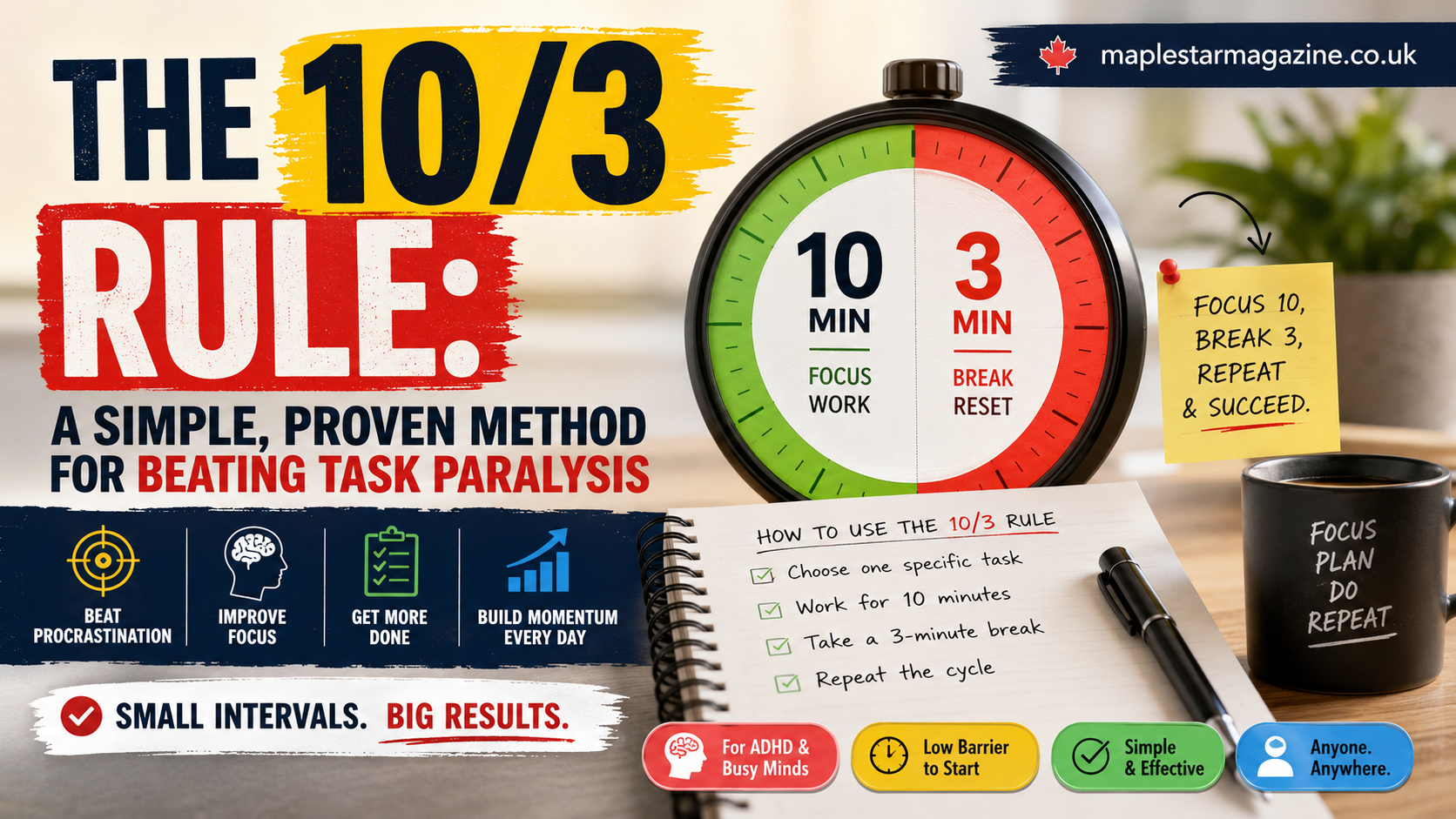
Roughly one in three US adults with ADHD receive no treatment at all, according to the CDC, and even among those in treatment, medication alone rarely solves the daily problem of simply starting a task. The 10/3 rule is a small, structured fix for exactly that problem: work with full focus for 10 minutes, take a 3-minute break, then repeat. No app, no course, no cost.
This guide from our lifestyle desk explains why the method works, how it stacks up against the Pomodoro Technique, and how to actually use it without turning your 3-minute break into 30.
Table of Contents
What Is the 10/3 Rule? A Quick Definition
The 10/3 rule is a short-interval focus technique: work on one task with full attention for 10 minutes, take a 3-minute break, then repeat the cycle. It is closely related to the Pomodoro Technique but uses shorter, lower-commitment blocks, which makes it easier to start tasks that feel too big or too dreaded to begin.
The method is especially popular among adults with ADHD, where task initiation, not motivation, is usually the actual obstacle, though anyone dealing with procrastination or a distracting workday can use it.
Why This Method Works
Three specific challenges explain why short cycles outperform willpower alone.
- Time blindness: a vague, open-ended task feels endless, while a visible 10-minute block feels finite and manageable
- Task paralysis: a large project overwhelms the brain, while a 10-minute sprint on one small piece of it does not
- Dopamine regulation: long, unrewarded work sessions feel draining, while short cycles create frequent small wins that reinforce motivation
Each of these three problems responds to the same underlying fix: shrinking the unit of commitment. A brain that struggles to accurately judge how long a task will take, or how bad it will feel once started, does not need a longer runway. It needs a shorter one, short enough that the cost of starting drops below the threshold that triggers avoidance in the first place.
How to Actually Do It
- Choose one specific task, not a vague goal (“write the first paragraph,” not “work on the report”)
- Set a timer for 10 minutes and commit to full focus, no email, no phone, no switching tasks
- Stop when the timer ends, even if momentum is building
- Take a genuine 3-minute break: stretch, walk, or drink water, not a scroll session
- Repeat the cycle for as many rounds as the task needs
10/3 vs. the Pomodoro Technique
The classic Pomodoro Technique uses 25 minutes of work followed by a 5-minute break. The 10/3 rule shrinks both numbers, trading some deep-focus time for a much lower barrier to starting. For tasks you have been avoiding for days, that lower barrier usually matters more than the extra 15 minutes of focus Pomodoro offers.
Who Benefits Most
Adults who struggle specifically with starting tasks, get distracted easily, or feel overwhelmed by large, ambiguous projects tend to see the fastest results. It is also a reasonable entry point for anyone who has tried Pomodoro and found even 25 minutes too long to commit to on a bad day.
Students cramming for exams, remote workers fighting midday distraction, and anyone facing a backlog of small administrative tasks, forms, emails, phone calls, also tend to respond well to the 10/3 rule specifically, since these tasks share the same profile: individually quick, collectively dreaded, and easy to keep pushing to tomorrow indefinitely.
Common Mistakes That Undo the Method
Making the task too big for a 10-minute block, skipping breaks entirely, or spending the break on something highly stimulating, like social media or video, are the three fastest ways to make the 10/3 rule stop working.
A subtler mistake is treating a single skipped cycle as failure. The method is meant to be resumed, not perfected. Missing a day, or stopping after one cycle instead of five, does not undo the value of the cycles that did happen, and treating it as an all-or-nothing system tends to be exactly what causes people to abandon it after a rough week.
Where a Method Like This Comes From
Short-interval work techniques are not new. The Pomodoro Technique, developed in the late 1980s, popularized the idea of timed work sprints decades ago, and various clinics and coaches have since adapted the same core principle into shorter formats to suit different attention spans and task types. The 10/3 rule sits at the more accessible end of that spectrum, alongside variations that stretch the interval out to 15 minutes of work or shrink it down to five, depending on who is using it and what they are working on that day.
A Real Example: The Email You Have Avoided for a Week
A common scenario looks like this: an email has been sitting unanswered for a week, not because it is complicated, but because opening it triggers a vague sense of dread. Under the 10/3 rule, the task is not “deal with the email.” It is “write the first two sentences of a reply,” set to a 10-minute timer. Most people find that once the timer starts and the first sentence exists, finishing the email during that same block, or the next one, is far easier than the version of the task that lived in their head for a week.
What makes this example useful is how ordinary it is. Nothing about that email was ever genuinely hard. The difficulty was entirely front-loaded into the moment of starting, and once that moment passed, the actual writing took less time than the days spent dreading it. That gap between imagined difficulty and real difficulty is where most procrastination actually lives, and it is the exact gap this method is built to close.
10/3 vs. Pomodoro vs. 50/10: Quick Comparison
| Method | Work Interval | Break | Best For |
| 10/3 Rule | 10 minutes | 3 minutes | Task paralysis, tasks you have been avoiding |
| Pomodoro Technique | 25 minutes | 5 minutes | General-purpose focus, moderate-difficulty tasks |
| 50/10 Method | 50 minutes | 10 minutes | Deep, complex work like writing or coding |
Building any new focus habit works better inside a broader daily structure. Our guide on improving focus and concentration naturally covers habits that support this kind of interval work beyond the timer itself.
Analysis and Insights
The counterintuitive insight is that shrinking the work interval is not simply making the task easier. It is specifically targeting the moment of starting, which research on ADHD and executive function consistently identifies as the actual point of failure, not sustained attention itself. Someone who struggles with the 10/3 rule‘s underlying problem can often sustain focus perfectly well once a task is underway. The barrier is almost entirely at the starting line, which is exactly why a technique built around lowering that one specific barrier tends to outperform generic advice like “just focus” or “try harder,” neither of which addresses where the actual difficulty lives.
One honest limitation: short-interval techniques like this one are variations on well-researched principles, time-blocking and structured breaks, rather than a single method that has itself been rigorously clinically tested in this exact 10-and-3 form. The 10/3 rule is a genuinely useful tool, not a replacement for treatment. Adults with a formal ADHD diagnosis and significant daily impairment should treat this as a complement to professional care, not a substitute for it.
Practical Recommendations for Getting Started
1. Define the Task Before You Start the Timer
Ambiguity is what causes avoidance in the first place. Write down the specific 10-minute action, not the whole project, before you press start, and keep that description short enough to fit in one sentence.
2. Use a Visual Timer, Not Just a Phone Countdown
Seeing time pass, a shrinking dial or a physical timer, makes the interval feel more real than a number counting down on a screen you are trying to avoid checking.
3. Protect the Break From High-Stimulation Content
Social media, video, and gaming during the break make returning to focus dramatically harder. Movement, water, or simply looking away from a screen resets attention without hijacking it.
4. Track Completed Cycles, Not Just Finished Tasks
A tally of completed 10-minute cycles builds visible momentum even on days when the underlying task is not fully finished, which matters more for motivation than it sounds.
5. Adjust the Ratio If 10 Minutes Still Feels Too Long
Some people start with 5-minute work blocks and build up. There is no rule that says the numbers have to be exactly 10 and 3 on day one.
6. Combine It With Body Doubling for Harder Days
Working alongside someone else, in person or on a video call, even silently, adds external accountability that pure time-blocking cannot provide on its own. Save this combination for your genuinely hardest tasks rather than every single cycle, since it takes more setup than working solo.
Frequently Asked Questions
| Q: What is the 10/3 rule? A: The 10/3 rule is a focus technique where you work on a single task for 10 minutes, take a 3-minute break, then repeat. It is designed to lower the barrier to starting tasks that feel overwhelming or easy to avoid. |
| Q: Is the 10/3 rule only for people with ADHD? A: No. It was popularized specifically for ADHD-related task paralysis, but anyone who procrastinates on a task or finds longer focus blocks too demanding can use it. |
| Q: How is the 10/3 rule different from Pomodoro? A: Pomodoro uses 25-minute work blocks with 5-minute breaks. The 10/3 rule uses much shorter 10-minute blocks with 3-minute breaks, which many people find easier to start, especially for tasks they have been avoiding. |
| Q: Can I change the 10/3 ratio? A: Yes. Some people use 15 minutes of work with a 5-minute break, or shrink it to 5-minute blocks on especially difficult days. The specific numbers matter less than the structure of short work followed by a real break. |
| Q: What should I do during the 3-minute break? A: Low-stimulation activities work best: stretching, walking, or drinking water. High-stimulation activities like social media or video tend to make it harder to return to focused work. |
| Q: Does the 10/3 rule actually work, or is it just a trend? A: It applies well-established time-management and behavioral principles, structured intervals and frequent small rewards, in a shorter format than traditional methods. It is not a clinically validated standalone treatment, but many people find it genuinely effective for task initiation. |
| Q: Should the 10/3 rule replace ADHD treatment? A: No. It is a practical daily tool, not a substitute for medication or therapy. Adults with significant ADHD-related impairment should use it alongside professional care, not instead of it. |
| Q: How many 10/3 cycles should I do in one work session? A: Three to four cycles, roughly 45 to 55 minutes total including breaks, is a common starting point before taking a longer rest. Adjust based on the task and your own energy that day rather than following a fixed number. |
Conclusion
The 10/3 rule works because it targets the actual point of failure for most procrastination and task paralysis: starting, not sustaining. Ten minutes of full focus followed by a genuine 3-minute break is small enough to feel doable on even the worst days, and that low barrier is the entire point. It costs nothing, requires no app, and can be tested on the very next task sitting in your inbox.
- Work 10 minutes, break 3 minutes, repeat, on one clearly defined task at a time
- It targets task initiation specifically, which is where most procrastination actually lives
- It is a shorter, lower-barrier alternative to the 25/5 Pomodoro Technique
- Protecting the break from high-stimulation content matters as much as the work interval itself
- It complements, but does not replace, professional ADHD treatment when significant impairment is present
Have you tried a short-interval method like this before, or is this your first 10-minute cycle? Tell us in the comments how it goes.

The Maple Star Magazine editorial team is responsible for the accuracy, structure, and publishing standards that every article on this site is held to. This includes verifying sources before publication, maintaining consistency across our Travel, Technology, Lifestyle and revisiting published guides as facts, pricing, or industry standards change. Content published under this byline reflects collaborative editorial work rather than a single author's individual reporting.