









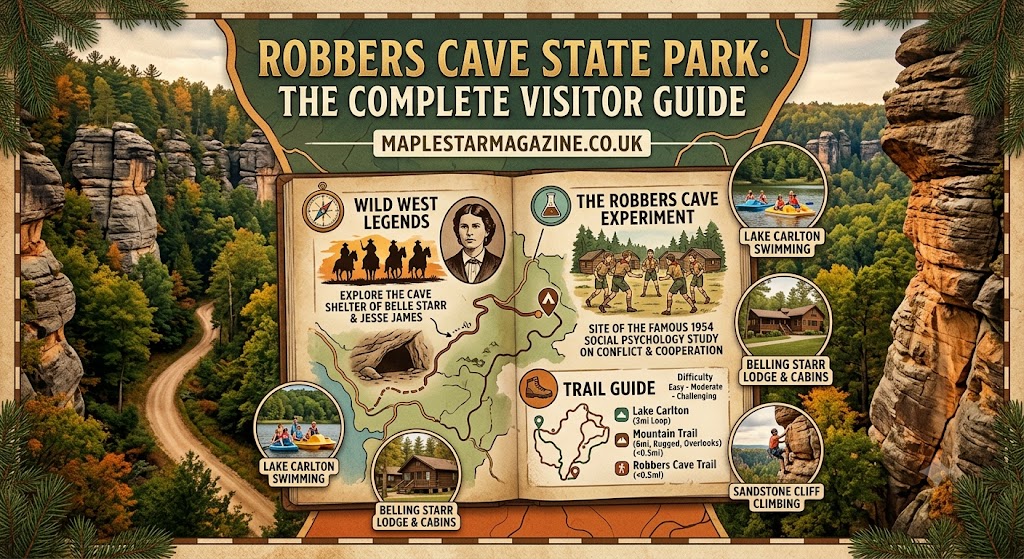
In 1954, a psychologist split 22 boys into two rival groups at a summer camp inside Robbers Cave State Park and accidentally produced one of the most cited studies in social psychology. Decades before that experiment, the same sandstone crevice the camp was named for is said to have sheltered Belle Starr and Jesse James. Few state parks anywhere pair genuine Wild West legend with a real chapter of behavioral science, and this one sits in a corner of southeast Oklahoma most travelers never think to visit.
This guide from our travel desk covers the park’s history, its trail system grouped by who each one actually suits, current entrance fees, and when to time a visit around Oklahoma’s seasons.
Table of Contents
What Is Robbers Cave State Park?
Robbers Cave State Park is an 8,000-plus acre state park in the Sans Bois Mountains of southeast Oklahoma, five miles north of Wilburton, built around a sandstone cave once used by 19th-century outlaws and three lakes created by Depression-era dam projects. Originally opened as Latimer State Park, it was renamed Robbers Cave in 1936 and added to the National Register of Historic Places in 2002, according to the Oklahoma Historical Society.
The park earns its outlaw reputation honestly: local legend holds that Belle Starr, the Younger brothers, the Dalton Gang, the Rufus Buck Gang, and Jesse James all used the cave’s near-impregnable terrain to hide from lawmen after the Civil War, escaping, according to the stories, through a hidden back exit.
The park’s built infrastructure tells a second, better-documented story. The Civilian Conservation Corps, part of President Franklin Roosevelt’s New Deal, arrived in 1933 and spent years building the cabins, roads, bathhouse, and shelters still in use today, along with damming Fourche Maline Creek to create Lake Carlton. That CCC-era construction is why the park’s stonework has a consistent, handcrafted look across its lodges, bridges, and trail markers, a detail hikers notice even without knowing the history behind it.
Best for History Buffs
The Robbers Cave Trail
Less than half a mile long, this short trail leads directly to the cave itself, a sandstone crevice large enough to walk through, with dramatic rock formations along the way. It is the single must-do stop for anyone visiting specifically for the outlaw history.
Best For: History buffs, casual visitors with limited time | Best Time to Visit: Fall for foliage, any season otherwise | US Access: About 3 hours from Oklahoma City by car; no passport needed
Best for Hikers
Mountain Trail
At roughly 6 miles, this is the park’s most demanding hike, climbing through rugged terrain to panoramic views from sandstone cliffs above Lake Wayne Wallace. Rock scrambling opportunities line several sections for hikers who want more than a walk.
Best For: Experienced hikers, photographers wanting overlook views | Best Time to Visit: Fall for cooler temperatures and color | US Access: Trailhead inside the park; day-use fee applies
Lake Carlton Trail and Cattail Pond Loop
The 3-mile Lake Carlton Trail loops the park’s main lake with steady, moderate terrain, while the roughly 4-mile Cattail Pond Loop circles the cave area itself and passes Lost Lake. Both suit hikers who want real mileage without Mountain Trail’s steeper climbs.
Best For: Intermediate hikers, birdwatchers | Best Time to Visit: Spring and fall | US Access: Trailheads inside the park; day-use fee applies
Best for Families and Water Activities
Lake Carlton and Coon Creek Swimming Areas
Two designated swimming areas give families a straightforward beach day without leaving the park, alongside canoe and paddleboat rentals on all three lakes. No lifeguards are on duty, so supervise kids directly rather than relying on staff.
Best For: Families, casual day-trippers | Best Time to Visit: Summer months for swimming; no personal watercraft allowed | US Access: Inside the park; day-use fee applies
Deep Ford Campground Loop and Outlaw Nature Trail
Both under a mile, these easy, flat trails suit young kids or anyone wanting a short walk rather than a hike, with the Outlaw Nature Trail adding interpretive signage about local plants and wildlife.
Best For: Young families, casual walkers | Best Time to Visit: Any season; shortest, flattest trails in the park | US Access: Inside the park; day-use fee applies
Best for an Overnight Stay
Belle Starr View Lodge and Cabins
The park’s 20-room lodge, cabins, yurts, and even covered wagons give visitors a genuine range of overnight options rarely found at a single state park, alongside standard RV, tent, and equestrian campsites.
Best For: Overnight visitors, equestrian travelers | Best Time to Visit: October for the Robbers Cave Fall Festival | US Access: Book ahead for October and summer weekends
Best for Climbers and Horseback Riders
Sandstone Cliff Climbing and Rappelling
The same sandstone bluffs that sheltered outlaws now draw rock climbers and rappellers, with routes scattered through the cave area and along Rough Canyon. No formal climbing gym or guide service operates inside the park, so experienced climbers bring their own gear and route knowledge.
Best For: Experienced climbers and rappellers | Best Time to Visit: Fall and spring, avoiding summer heat on exposed rock | US Access: Cave area and Rough Canyon; day-use fee applies
Equestrian Trails and Stables
A dedicated equestrian campground and stables serve horseback riders on trails separate from the main hiking network, with scenic bluff-top routes that rival Mountain Trail’s views without sharing the same foot traffic.
Best For: Horseback riders bringing their own horses | Best Time to Visit: Spring and fall for comfortable riding temperatures | US Access: Equestrian campground inside the park; separate trail network
A Real Example: The Robbers Cave Experiment
In 1954, psychologist Muzafer Sherif ran what became known as the Robbers Cave Experiment at a Boy Scout camp inside the park, splitting 22 boys into two groups who were not told about each other at first. The study, foundational to realistic conflict theory, showed how quickly competition between groups escalates into hostility and how shared goals could later reduce it. It remains one of the most cited studies in social psychology, and the park itself, not a recreation, is where it happened.
What makes the experiment worth knowing before you visit is how ordinary the actual camp facilities were. Sherif chose the site for its isolation, not for any special research infrastructure, and the same rustic cabins-and-woods setting that suited a mid-century psychology study is largely what a modern visitor still finds today. Nothing at the park is staged around the experiment. There is no marker at a specific cabin, and most day visitors walk right past the general camp area without knowing its research history at all.
Trail Difficulty at a Glance
| Trail | Distance | Difficulty |
| Robbers Cave Trail | Under 0.5 miles | Easy, with light rock scrambling near the cave |
| Outlaw Nature Trail | 0.5 miles | Easy, flat interpretive walk |
| Deep Ford Campground Loop | Under 1 mile | Easy, flat, family-friendly |
| Rough Canyon Trail | About 1 mile | Moderate, steep in sections |
| Lake Carlton Trail | 3 miles | Moderate loop around the main lake |
| Coon Creek Bridge and Lookout Point Trails | About 3 miles combined | Moderate, creekside with lookout climbs |
| Cattail Pond Loop | About 4 miles | Moderate loop past Lost Lake |
| Mountain Trail | About 6 miles | Challenging, steep with panoramic overlooks |
Planning a longer Oklahoma or Texas loop around this stop? Our guide to budgeting for a US road trip covers how to price out gas, camping, and lodging across a multi-stop itinerary.
Analysis and Insights
The counterintuitive insight about Robbers Cave is that its two defining stories, Wild West outlaws and a landmark psychology experiment, both hinge on the same physical feature: terrain rugged and enclosed enough to hide 19th-century fugitives is exactly the kind of isolated setting a mid-century researcher would choose to study group behavior away from outside influence. The park’s geography, not just its history, is the actual throughline.
One honest limitation: much of the outlaw history here rests on local legend rather than fully documented fact. Historical markers and state tourism sources repeat the Belle Starr and Jesse James connections consistently, but readers should treat them as a well-preserved regional legend passed down through generations rather than courtroom-verified history.
A second, smaller limitation: this guide focuses on hiking, climbing, water activities, and history rather than birdwatching, even though the park’s mixed forest and lake habitats draw woodpeckers, hawks, and warblers year-round, with migration season bringing the widest variety. Serious birders should treat the trail descriptions above as a starting point and pick up the nature center’s species checklist on arrival rather than relying on this guide alone for that specific activity.
Practical Recommendations for Visiting
1. Pay the Entrance Fee Online or at the Gate Before You Arrive
Oklahoma has charged a per-vehicle entrance fee at this park since June 2020, starting at 10 dollars per day, 8 dollars with an Oklahoma plate, per TravelOK.com, the state’s official tourism site. Veterans and Oklahoma residents 62 and older ride free, and multi-day or annual passes, good across all 22 fee-charging Oklahoma state parks, cost less per visit if you plan to return more than once a year.
2. Book Lodging Months Ahead of the October Fall Festival
The Robbers Cave Fall Festival draws more than 80,000 visitors each October, and the lodge and cabins sell out well before the event. Book as early as you can if a fall foliage trip is the goal, and expect nearby Wilburton’s own accommodations to fill up as a backup option too.
3. Match the Trail to Your Actual Fitness Level, Not Your Ambition
Mountain Trail’s 6 miles and steep sandstone climbs surprise hikers expecting an easy state park walk. Start with Lake Carlton Trail or the Cattail Pond Loop if you are unsure how the terrain will feel, and treat Mountain Trail as an afternoon commitment rather than a quick add-on to a packed day.
4. Bring Your Own Life Jackets for Swimming
Neither designated swimming area has a lifeguard on duty. Treat both lakes the way you would any unsupervised natural swimming spot, especially with kids, and check for posted water quality or algae advisories at the nature center before getting in.
5. Check Trout Stocking Season Before Planning a Fishing Trip
Trout fishing runs seasonally rather than year-round. Confirm current stocking dates before booking a trip built specifically around fishing.
6. Pack for Genuine Temperature Swings
The Sans Bois Mountains see real seasonal variation, and the sandstone terrain holds heat in summer and cold in shaded canyon sections even on mild days. Layer accordingly regardless of the season.
Frequently Asked Questions
| Q: Why is it called Robbers Cave?A: The park is named for a sandstone cave where local legend says 19th-century outlaws, including Belle Starr and Jesse James, hid from lawmen after the Civil War, reportedly escaping through a hidden back exit. |
| Q: How much does it cost to enter Robbers Cave State Park?A: Oklahoma has charged a per-vehicle entrance fee since June 2020, starting at 10 dollars per day, or 8 dollars with an Oklahoma license plate. Veterans and Oklahoma residents 62 and older are exempt. |
| Q: How far is Robbers Cave from Oklahoma City?A: The park sits roughly 3 hours east of Oklahoma City by car, about 165 miles, in the Sans Bois Mountains near Wilburton. |
| Q: Can you swim at Robbers Cave State Park?A: Yes, at two designated swimming areas on Lake Carlton and Coon Creek Lake. Neither has a lifeguard on duty, so swim at your own risk and supervise children closely. |
| Q: Is Robbers Cave State Park good for beginner hikers?A: Yes, with the right trail choice. The Outlaw Nature Trail and Deep Ford Campground Loop are both under a mile and flat, while Mountain Trail’s 6 miles of steep terrain suits experienced hikers only. |
| Q: What is the Robbers Cave Experiment?A: It was a 1954 social psychology study by Muzafer Sherif conducted at a Boy Scout camp inside the park, splitting 22 boys into two rival groups to study how conflict and cooperation develop between groups. It remains a foundational study in realistic conflict theory. |
| Q: What is the best time of year to visit Robbers Cave State Park?A: Fall is the most popular season, both for cooler hiking temperatures and the annual Robbers Cave Fall Festival in October, which draws more than 80,000 visitors and requires booking lodging well in advance. |
| Q: Can you go rock climbing at Robbers Cave State Park?A: Yes. The sandstone cliffs around the cave area and Rough Canyon draw climbers and rappellers, though no guide service or gear rental operates inside the park, so experienced climbers should bring their own equipment. |
Conclusion
Robbers Cave State Park earns its name from a genuine 19th-century outlaw legend and its academic reputation from a landmark 1954 psychology experiment, both tied to the same rugged Sans Bois Mountains terrain that makes it worth the drive from Oklahoma City or Dallas. Few state parks anywhere combine that much documented and legendary history with a genuinely varied trail system in one visit.
- The park spans over 8,000 acres with three lakes, five miles north of Wilburton, Oklahoma
- Local legend ties the cave itself to outlaws including Belle Starr and Jesse James
- Muzafer Sherif’s landmark 1954 Robbers Cave Experiment took place at the park’s Boy Scout camp
- Trail difficulty ranges from a flat half-mile nature walk to a challenging 6-mile Mountain Trail
- October’s Fall Festival draws 80,000-plus visitors, so book lodging months ahead
Are you drawn more by the outlaw history or the hiking? Tell us in the comments which trail you would tackle first.

The Maple Star Magazine editorial team is responsible for the accuracy, structure, and publishing standards that every article on this site is held to. This includes verifying sources before publication, maintaining consistency across our Travel, Technology, Lifestyle and revisiting published guides as facts, pricing, or industry standards change. Content published under this byline reflects collaborative editorial work rather than a single author's individual reporting.