






Introduction
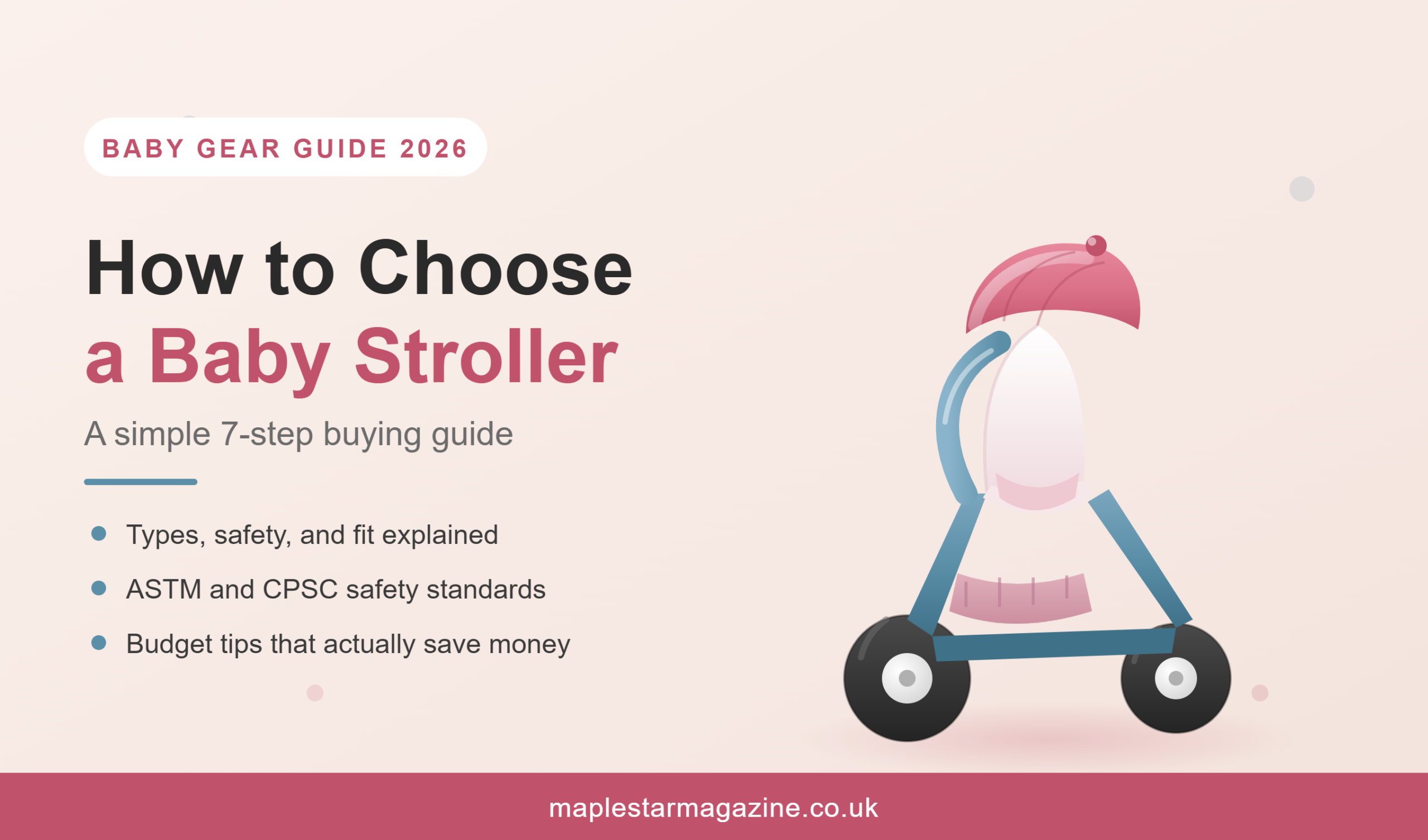
A baby stroller is one of the largest purchases on any registry, with prices ranging from around $100 for a basic model to more than $1,500 for a high-end European brand, and most families keep using theirs daily until their child is three or four years old. Learning how to choose a baby stroller before you shop saves you from the most common regret parents report: buying based on looks, then discovering it does not fit your car, your stairs, or your actual routine.
At Maple Star Magazine, we break this decision down the way pediatric safety experts and consumer testers actually approach it: type first, safety second, then the practical details that decide whether you love or resent your stroller six months in. This guide walks through all seven steps, backed by CPSC safety standards and current 2026 market data.
Step 1: Know the Stroller Types
Here is the direct answer for anyone short on time: choosing a baby stroller means matching one of six main types (full-size, lightweight, jogging, travel system, car-seat frame, or double) to your daily routine, verifying it meets ASTM F833-21 safety standards, and checking weight and fold size against your car and living space.
Each type solves a different problem, and recognizing which one you actually need narrows the market fast.
Full-Size (Traditional) Strollers
Full-size strollers are the everyday workhorses parents push through malls, parks, and neighborhood walks. They typically weigh 20 to 30 pounds and include suspension systems, large canopies, and generous storage baskets. Most accept an infant car seat adapter for the newborn months, though without one, many full-size seats are only appropriate from around 6 months once a baby has head and trunk control.
Lightweight and Umbrella Strollers
Lightweight strollers trade some comfort features for portability, with models like the Momcozy ClickGo weighing just 19 pounds and travel-focused options such as the Babyzen YOYO2 and GB Pockit built to fit airplane overhead bins at under 15 pounds. They are ideal as a second stroller for errands or as a primary stroller for frequent flyers, though they typically offer less padding and storage than full-size models.
Jogging Strollers
Jogging strollers feature three wheels, including a front wheel that swivels for walking and locks for running, plus air-filled tires that absorb shock on trails and gravel. Consumer Reports notes these are not appropriate for infants under 6 months, and recommends checking with a pediatrician before running with any child under 1 year, since babies need sufficient neck strength first. Expect 25 to 30 pounds and reduced maneuverability in tight indoor spaces.
Travel Systems and Car-Seat Frame Strollers
A travel system bundles a stroller with a matching infant car seat that clicks directly onto the frame, which lets you move a sleeping baby from car to stroller without waking them. A car-seat frame stroller is a lighter, budget-friendly alternative: a wheeled frame with no seat of its own that simply holds your existing infant car seat, useful only until your baby outgrows that seat around 12 months.
Double and Modular Strollers
Double strollers serve twins or siblings close in age, while modular systems like a convertible frame can grow from a single seat to a double by adding a second seat later. Modular strollers cost more upfront but often hold stronger resale value, since many parents specifically seek out an expandable model for a second child.
Step 2: Understand Safety Standards and Certifications
Safety is not a feature to compare, it is a baseline every stroller must clear before anything else matters. In the United States, the Consumer Product Safety Commission requires every stroller sold to meet 16 CFR Part 1227, which incorporates ASTM F833-21, the current mandatory performance standard, effective for products manufactured on or after February 15, 2022.
What ASTM F833-21 Actually Tests
This standard covers stability and tip-over resistance, parking brake holding power, restraint and harness systems, latching and folding mechanisms, structural integrity, wheel attachment, and entrapment-hazard openings, according to CPSC’s own business guidance. A compliant stroller carries a permanent tracking label with the manufacturer name, model, and manufacture date, plus a postage-paid registration card so you can be notified of any recall.
What Certification Labels Mean
Look for the Baby Safety Alliance seal, the 2026 rebrand of what many parents still know as JPMA certification. The program independently tests products at accredited labs across roughly 30 juvenile product categories and requires annual retesting, which adds a layer of verification beyond a brand’s own claims on the box.
The American Academy of Pediatrics recommends looking for a wide wheelbase, a locking mechanism that engages reliably, brakes that are simple to operate, and a secure harness, according to its published guidance on choosing a safe stroller.
Step 3: Match Weight and Fold to Your Daily Routine
Weight matters more in daily life than almost any other spec on the box. If you lift your stroller into a car trunk, up stairs, or in and out of rideshares multiple times a day, every pound counts significantly more than it does on a showroom floor.
Ask Yourself These Questions First
- Do you carry the stroller up stairs regularly? Weight should lead your priority list
- Do you drive a small car? Folded size matters more than open comfort
- Do you travel by plane often? Look specifically at sub-15-pound, carry-on-compatible models
- Do grandparents or other caregivers use it too? Simple, intuitive fold controls matter more than advanced features
Test the Fold Before You Buy
A one-hand fold makes a real difference when you are holding a baby in one arm and managing a diaper bag in the other. Practice folding any stroller in the store rather than trusting a product video. Some mechanisms are genuinely intuitive; others turn into a wrestling match in a parking lot with a fussy toddler waiting.
Step 4: Check Age and Newborn Readiness
Not every stroller works from day one, and getting this wrong is one of the most common newborn-gear mistakes. For the first months, a baby needs a fully reclining seat or a dedicated bassinet attachment that supports a flat, neutral head and neck position. Upright, non-reclining seats are not appropriate until a baby has developed sufficient head and trunk control, typically around 6 months.
A travel system with an infant car seat bridges this gap for short walks, but a car seat position is not a substitute for a true lie-flat position on longer outings. If you plan to use a full-size stroller from birth, confirm the manufacturer explicitly rates it as newborn-ready, or plan to add a compatible car seat adapter or bassinet.
Step 5: Set a Realistic Budget
Stroller prices span an enormous range, from roughly $100 for a basic lightweight model to more than $1,500 for premium European brands, and Forbes Vetted reported that tariff-driven price increases added $200 or more to many popular models between 2024 and 2025, with prices holding relatively steady into early 2026.
Rather than chasing the lowest price or the flashiest brand, calculate cost per use. A $300 stroller used daily for three years costs roughly 27 cents per day. A $470 travel system bundling a car seat and stroller, like the Britax Willow Brook, can outperform buying pieces separately once you factor in that combination value. It is often better to spend more upfront on a durable model than to replace two cheap strollers that wear out within a year.
Type Comparison Table
| Stroller Type | Typical Weight | Best For | Newborn Ready? |
| Full-size / traditional | 20-30 lbs | Daily use, comfort, storage, long walks | Only with car seat adapter or bassinet |
| Lightweight / umbrella | 15-19 lbs | Errands, travel, second stroller | Usually no; check model specs |
| Jogging stroller | 25-30 lbs | Running, trails, uneven terrain | No, wait until 6-12 months per CR |
| Travel system | Varies (bundle) | Newborns, frequent car-to-stroller moves | Yes, via included infant car seat |
| Car-seat frame | Under 15 lbs | Budget newborn option, short-term use | Yes, until car seat is outgrown (~12 mo) |
| Double / modular | 30+ lbs | Twins, siblings, growing families | Depends on configuration |
Comparing infant car seats to pair with your new stroller? Our full breakdown of car seat safety ratings walks through the same CPSC standards in more depth. [Add internal link to: infant car seat buying guide]
Analysis: The Question Most Guides Skip
Here is what years of parent interviews and safety data reveal that most stroller articles gloss over: the biggest source of buyer’s remorse is not a bad stroller, it is the right stroller bought for the wrong lifestyle. A $1,200 luxury full-size stroller with premium suspension is a genuinely excellent product, and also a genuinely bad purchase for a family in a third-floor walk-up apartment who folds it every single day. The stroller did not fail. The fit did.
The counterintuitive insight worth sitting with: expensive and safe are not the same axis. Every stroller legally sold in the US, from a $100 umbrella model to a $1,500 luxury pushchair, must clear the identical ASTM F833-21 safety floor enforced by the CPSC. Price above that floor buys you materials, ride smoothness, resale value, and design, not a meaningfully safer harness or brake system. That reframes the budget conversation entirely: spend up for comfort and durability if it fits your life, not out of a belief that more money equals more safety.
One honest limitation worth naming: safety standards test a stroller in laboratory conditions, not your specific sidewalk, stairwell, or subway platform. Baby Safety Alliance’s own director has noted that the most frequent real-world stroller incidents involve correct products used incorrectly, not certified products failing outright, such as not buckling the harness fully or hanging a heavy bag on the handlebar, which can tip a stroller backward.
7 Practical Tips Before You Buy
1. Test the Fold and Push in Person, Not Just Online
Visit a store and physically fold, unfold, and push any stroller you are seriously considering. What looks effortless in a product video can feel completely different in your own hands, and this single test prevents the most common post-purchase regret.
2. Measure Your Trunk and Front Door Before Ordering
Check your car’s trunk dimensions and any tight doorways or elevators in your home against the stroller’s folded measurements. A stroller that will not fit your actual daily spaces becomes a stroller that stays in the garage.
3. Register the Product the Day It Arrives
Fill out the postage-paid registration card or register online immediately after unboxing. This is the only reliable way manufacturers can reach you directly if a recall is issued later, rather than hoping you see a news story.
4. Confirm Newborn Readiness Before Assuming It
If you plan to use your primary stroller from birth, check the manufacturer’s specific age and weight rating rather than assuming any stroller works for a newborn. Add a compatible bassinet or car seat adapter if the seat itself is not rated for lie-flat use.
5. Never Hang Heavy Bags Directly on the Handlebar
A loaded diaper bag hung on the handles shifts the stroller’s center of gravity and is a documented cause of tip-overs, according to Baby Safety Alliance safety guidance. Use the built-in storage basket underneath instead, which is designed to carry weight safely.
6. Buy the Car Seat New, Even If the Stroller Is Used
Stroller frames without fabric issues are often fine secondhand, but car seats should always be purchased new. You cannot verify a used seat’s full crash history, and expiration dates on car seats exist for real structural reasons.
7. Recheck the Harness Every Single Ride
The most frequently reported stroller safety mistake is an incorrectly used restraint system, not a defective one. Make buckling the five-point harness fully, every time, as automatic as putting on your own seatbelt.
Frequently Asked Questions
Q: What is the most important thing to consider when choosing a baby stroller?
Match the stroller type to your actual daily routine first: where you walk, how you store it, and whether you carry it up stairs. Safety certification (ASTM F833-21 compliance) is the non-negotiable baseline every stroller must meet regardless of type.
Q: How much should I spend on a baby stroller?
Prices range from about $100 to over $1,500. Calculate cost per use rather than chasing the lowest price: a $300 stroller used daily for three years costs about 27 cents a day, and durable mid-range models often outlast cheaper ones.
Q: Can a stroller be used from birth?
Only if the manufacturer specifically rates it as newborn-ready with a full recline or bassinet attachment. Upright, non-reclining seats are not appropriate until a baby has head and trunk control, typically around 6 months.
Q: What safety standard do baby strollers need to meet in the US?
All strollers sold in the US must comply with 16 CFR Part 1227, which incorporates ASTM F833-21. This covers stability, brakes, harness systems, folding mechanisms, wheel attachment, and entrapment hazards.
Q: What is the difference between JPMA certification and ASTM compliance?
ASTM F833-21 compliance is the legally required safety floor. Baby Safety Alliance certification, the 2026 rebrand of JPMA, is an additional voluntary program with independent lab testing and annual retesting across about 30 product categories.
Q: When can a baby use a jogging stroller?
Consumer Reports notes jogging strollers are not appropriate for infants under 6 months, and recommends not running with children under 1 year regardless, since babies need sufficient neck strength. Always confirm with your pediatrician first.
Q: How long do children typically use a stroller?
Most children use a stroller regularly until around age 3 to 4, and occasionally for longer outings until age 5. This is why many parents consider a modular or double-compatible option if planning more children.
Conclusion
Learning how to choose a baby stroller comes down to matching type to lifestyle, confirming real safety compliance, and being honest about your daily routine before your budget or brand preferences enter the picture. The right stroller is not the most expensive or most popular one online, it is the one you will actually use without frustration for the next three or four years.
Key takeaways:
- Identify your stroller type first: full-size, lightweight, jogging, travel system, car-seat frame, or double
- Every legal stroller in the US must meet ASTM F833-21 through 16 CFR Part 1227, regardless of price
- Weight and fold size matter more in daily life than almost any other spec
- Confirm newborn readiness explicitly rather than assuming any stroller works from birth
- Calculate cost per use instead of chasing the lowest sticker price
Test it, fold it, and picture your actual Tuesday morning before you buy. What matters most to you in a stroller: weight, storage, or ride smoothness? Tell us in the comments.

The Maple Star Magazine editorial team is responsible for the accuracy, structure, and publishing standards that every article on this site is held to. This includes verifying sources before publication, maintaining consistency across our Travel, Technology, Lifestyle and revisiting published guides as facts, pricing, or industry standards change. Content published under this byline reflects collaborative editorial work rather than a single author's individual reporting.