









Most physics students hit a wall the moment motion problems get serious. You know something is moving, you have a few numbers and you are supposed to find one more. But which formula do you use? The SUVAT equations are the answer to that question and once you understand how they work the confusion disappears almost completely.
SUVAT equations are a set of five formulas that describe the motion of an object moving in a straight line with constant acceleration. Every variable in every formula connects to something you can measure: displacement, initial velocity, final velocity, acceleration and time. When you know three of those five values the equations let you find the other two with nothing more than algebra.
These equations sit at the core of physics fundamentals and they appear on almost every major physics exam in the United States including AP Physics 1, AP Physics C: Mechanics and introductory college physics courses. This guide explains every formula clearly, shows you exactly how to pick the right one and walks through worked examples so you can see the process in action.
What Are SUVAT Equations?
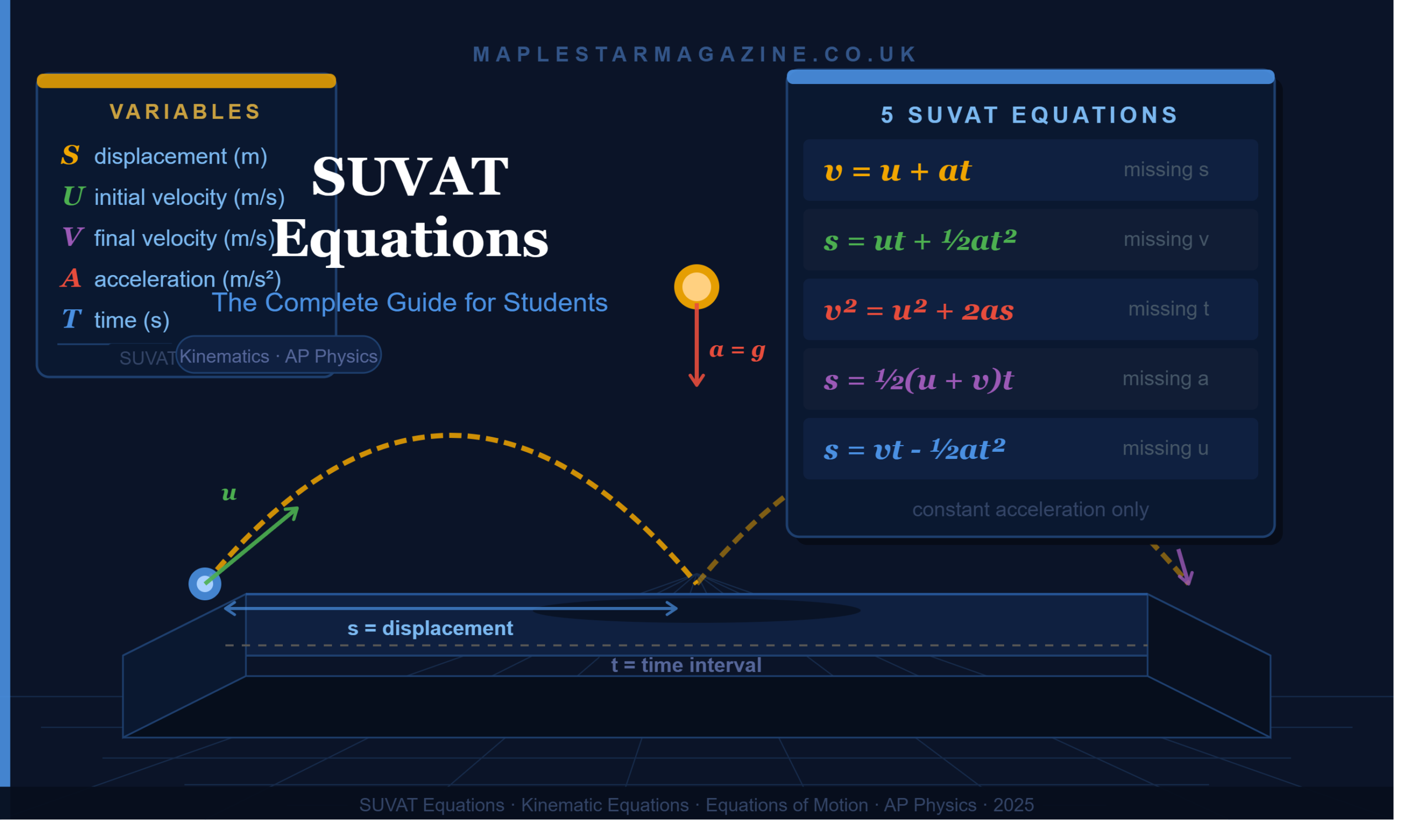
SUVAT equations are the five kinematic equations of motion used in physics to describe straight-line motion under constant acceleration. The name SUVAT is an acronym formed from the five variables used in the equations: S for displacement, U for initial velocity, V for final velocity, A for acceleration and T for time.
These are the same formulas called kinematic equations or equations of motion in American textbooks. The label changes depending on where you study. British A-Level and GCSE syllabuses use the term SUVAT. US courses like AP Physics 1 call them kinematic equations and sometimes use different symbols such as v0 for initial velocity or x for displacement. The math behind them is identical regardless of which label your course uses.
The single most important rule about SUVAT equations is this: they only work when acceleration is constant. The moment acceleration changes the equations no longer apply and you need calculus-based methods instead. For the vast majority of problems in a first physics course, including projectile motion and free fall, acceleration is constant so the SUVAT equations handle them perfectly.
The History Behind the Kinematic Equations
The physics that the SUVAT equations describe was first worked out by Galileo Galilei (1564 to 1642). Before Galileo, the accepted view going back to Aristotle was that heavier objects fall faster than lighter ones and that a constant force produces constant speed rather than constant acceleration. Both ideas were wrong.
Galileo tested these assumptions by rolling bronze balls down a grooved wooden ramp, a method he described in detail in his book Discourses on Two New Sciences, published in 1638. By timing the balls with a water clock he showed that the distance traveled was proportional to time squared, exactly what the equation s = ut + half at squared predicts. He had discovered uniform acceleration through direct experiment two centuries before the formulas were written in their modern algebraic form.
Isaac Newton’s Principia Mathematica published in 1687 provided the explanation for why objects accelerate the way they do: a net force acting on a mass produces acceleration. But the kinematic equations themselves were observational discoveries first. The laws of motion gave the cause and the SUVAT equations describe the result. Both are essential to understanding motion in classical physics.
What Each Variable Means
Before using any kinematic formula you need to be clear on what each letter represents. Here is every SUVAT variable with its unit and its physical meaning.
| Letter | Variable | SI Unit | What It Means |
| S | Displacement | meters (m) | Distance moved in a specific direction from the starting point |
| U | Initial Velocity | meters per second (m/s) | The speed of the object at the start of the time period |
| V | Final Velocity | meters per second (m/s) | The speed of the object at the end of the time period |
| A | Acceleration | meters per second squared (m/s²) | The rate at which velocity changes per second |
| T | Time | seconds (s) | The duration of the motion being analyzed |
One important distinction: displacement is not the same as distance. Distance is how far an object travels along its path. Displacement is how far it ends up from where it started measured in a straight line in a specific direction. If you walk 5 meters forward and then 5 meters back your distance is 10 meters but your displacement is 0. SUVAT equations use displacement not distance.
All 5 SUVAT Equations with Formulas
There are five kinematic equations in the SUVAT system. Each one leaves out one of the five variables which is what makes the set so useful. When you know which variable you do not have or do not need you can immediately identify which equation to use.
| No. | Equation | Missing Variable | Use When |
| 1 | v = u + at | s (displacement) | You know u, a, t and need v |
| 2 | s = ut + ½at² | v (final velocity) | You know u, a, t and need s |
| 3 | v² = u² + 2as | t (time) | You know u, a, s and need v (or vice versa) |
| 4 | s = ½(u + v)t | a (acceleration) | You know u, v, t and need s |
| 5 | s = vt – ½at² | u (initial velocity) | You know v, a, t and need s |
You only need to memorize equations 1 through 4. Equation 5 is a rearrangement and most US physics courses treat it as optional. The College Board AP Physics 1 exam equation sheet provides three of these kinematic equations directly so you will not need to recall them from memory on exam day.
Where These Equations Come From
All five SUVAT equations come from two basic definitions: acceleration equals change in velocity divided by time and average velocity equals displacement divided by time. Starting from those two ideas and applying algebra produces the full set of kinematic equations. You do not need calculus to derive them at the introductory level.
Equation 1 (v = u + at) comes directly from the definition of constant acceleration: if velocity changes by a each second then after t seconds the final velocity is the initial velocity plus a times t.
Equation 2 (s = ut + half at squared) comes from calculating the area under a velocity-time graph. An object starting at velocity u and accelerating at rate a traces a trapezoid on the graph. The area of that shape equals the displacement and working out the area gives the formula.
Equation 3 (v squared = u squared + 2as) is derived by combining equations 1 and 2 to eliminate t. It is the most useful equation for problems where time is not given and not needed.
How to Choose the Right SUVAT Equation
This is the step most students skip and it is the reason most errors happen. Before you write any formula you need to do three things in order.
- List all five SUVAT variables: s, u, v, a and t
- Write down the values you are given in the problem
- Identify which variable you are asked to find
Once you have done that look at which variable is neither given nor required. That missing variable tells you which equation to use. If time is not in the problem and you do not need it, use equation 3. If final velocity is not in the problem and you do not need it, use equation 2.
A worked example: A car starts from rest and accelerates at 3 meters per second squared for 8 seconds. How far does it travel?
Step 1: list the variables. u = 0 (starts from rest), a = 3 m/s squared, t = 8 s, s = unknown, v = not given and not needed.
Step 2: v is the missing variable so use equation 2: s = ut + half at squared.
Step 3: s = (0)(8) + half times (3) times (8 squared) = 0 + 1.5 times 64 = 96 meters.
The car travels 96 meters.
Worked Examples Step by Step
Example 1: Free Fall
A ball is dropped from rest from a building. Gravitational acceleration on Earth is 9.8 meters per second squared. The ball hits the ground after 3 seconds. Find the displacement and the final velocity.
Known values: u = 0 (dropped from rest), a = 9.8 m/s squared (taking downward as positive), t = 3 s. Unknown: s and v.
Find s using equation 2: s = ut + half at squared = (0)(3) + half times (9.8) times (9) = 0 + 44.1 = 44.1 meters.
Find v using equation 1: v = u + at = 0 + (9.8)(3) = 29.4 meters per second.
The ball falls 44.1 meters and hits the ground at 29.4 meters per second.
Example 2: Finding Acceleration
A cyclist is moving at 12 meters per second. She brakes and stops after traveling 36 meters. What is her deceleration?
Known values: u = 12 m/s, v = 0 (she stops), s = 36 m. Unknown: a. Time is not given and not needed.
Use equation 3: v squared = u squared + 2as. Substituting: 0 = (12 squared) + 2(a)(36). So 0 = 144 + 72a. Solving: a = negative 144 divided by 72 = negative 2 m/s squared.
The deceleration is 2 meters per second squared. The negative sign confirms the object is slowing down.
Example 3: Vertical Throw Upward
A ball is thrown straight up with an initial velocity of 15 meters per second. Taking upward as positive and gravitational acceleration as negative 9.8 meters per second squared, find the maximum height the ball reaches.
At maximum height the final velocity v = 0 because the ball momentarily stops before falling back. Known values: u = 15 m/s, v = 0, a = negative 9.8 m/s squared. Unknown: s. Time is not needed.
Use equation 3: v squared = u squared + 2as. So 0 = (15 squared) + 2(negative 9.8)(s). Therefore 0 = 225 minus 19.6s. Solving: s = 225 divided by 19.6 = 11.48 meters.
The ball reaches a maximum height of approximately 11.5 meters.
SUVAT Equations in the US Physics Curriculum
In the United States these equations are taught under the label kinematic equations rather than SUVAT. The variable names are slightly different from British notation but the formulas are mathematically identical.
| Variable Meaning | US / AP Physics Notation | SUVAT Notation |
| Displacement | x or delta x | s |
| Initial velocity | v0 or vi | u |
| Final velocity | v or vf | v |
| Acceleration | a | a |
| Time | t | t |
The College Board AP Physics 1 exam provides the three most commonly used kinematic equations on its official reference sheet. Students do not need to memorize them for the exam but they do need to understand which equation applies to which situation and be able to manipulate the algebra quickly under timed conditions.
AP Physics C: Mechanics covers the same kinematic equations but goes further by deriving them using calculus. Students in that course need to be comfortable differentiating and integrating velocity and position functions as well as applying the algebraic versions in their simplified constant-acceleration form.
Common Mistakes Students Make with Kinematic Equations
These are the errors that appear most often in physics classrooms and on exams. Knowing them in advance saves you from losing marks on problems you actually understand.
Mistake 1: Using SUVAT When Acceleration Is Not Constant
This is the most serious and most common error. SUVAT equations for motion require constant acceleration throughout the entire time period. If an object speeds up then slows down or changes direction while accelerating the equations give wrong answers. Always confirm that acceleration is uniform before applying any kinematic formula.
Mistake 2: Forgetting Sign Conventions
Velocity and acceleration are vectors. They have direction. You must choose a positive direction at the start of each problem and stick with it all the way through. If you take upward as positive then downward acceleration due to gravity must be entered as negative 9.8 meters per second squared not positive 9.8. Flipping signs mid-problem is the fastest way to get a wrong answer on a problem you set up correctly.
Mistake 3: Confusing Displacement with Distance
SUVAT equations work with displacement not total distance. If an object throws up, reaches its peak and falls back down the displacement at the end is 0 but the total distance traveled is twice the maximum height. Always check what the question is actually asking for before calculating.
Mistake 4: Skipping the Variable List
Many students read the problem and jump straight to writing a formula. This almost always leads to choosing the wrong equation. The two minutes spent listing s, u, v, a and t and identifying which are known and which are unknown will save far more time than they cost.
Mistake 5: Incorrect Substitution of Units
Every SUVAT equation assumes SI units: meters for displacement, meters per second for velocity, meters per second squared for acceleration and seconds for time. If a problem gives you speed in kilometers per hour or distance in centimeters you must convert before substituting into any kinematic formula.
Practical Tips for Mastering SUVAT Equations
These strategies are used by students who consistently score well on kinematic problems. They apply whether you are studying for AP Physics, a college intro course or just trying to understand uniformly accelerated motion for the first time.
- Write the variable list for every single problem. Make it a non-negotiable habit. List s, u, v, a, t. Mark what you know and what you need. Do this even when it feels slow. After two weeks it becomes automatic and fast.
- Learn the missing variable trick. The variable that is neither given nor needed points you directly to the right equation. Equation 1 is missing s. Equation 2 is missing v. Equation 3 is missing t. Equation 4 is missing a. Equation 5 is missing u. Memorize this pattern and you will never waste time hunting through formulas again.
- Always define your positive direction first. Write it at the top of every problem. Then every value in every equation gets a sign based on that choice. Gravity is always negative 9.8 m/s squared if upward is positive. This one habit eliminates most sign errors.
- Practice free fall problems separately. Free fall is constant acceleration at 9.8 meters per second squared downward on Earth. It is the most common context for SUVAT problems in US exams and it follows the same rules as any other uniformly accelerated motion. Treat it as a special case worth extra practice time.
- Use free simulation tools to build physical intuition alongside the algebra. PhET Interactive Simulations from the University of Colorado Boulder lets you adjust initial velocity and acceleration in real time and watch displacement graphs update instantly. Connecting the numbers in the equations to visual motion is what makes the formulas feel logical rather than arbitrary.
- Check your answer for physical sense before you move on. If a ball thrown upward comes back down after 5 seconds and your calculation gives a negative displacement something is wrong with your signs. If a car traveling at 20 meters per second stops in 0.01 seconds your acceleration number will be enormous, which would signal a unit error or a misread problem. Physical sense-checking catches errors that algebra alone does not.
Frequently Asked Questions
What does SUVAT stand for?
SUVAT stands for the five variables in the kinematic equations of motion: S is displacement, U is initial velocity, V is final velocity, A is acceleration and T is time. The acronym is standard in British physics education. US courses use the same equations under the name kinematic equations.
Are SUVAT equations the same as kinematic equations?
Yes. They are the same five equations with different variable names. In the US, initial velocity is often written as v0 and displacement as x or delta x. In British notation the same values are written as u and s. The mathematical form and the results are identical.
Can SUVAT equations be used for projectile motion?
Yes but you apply them separately in each direction. Horizontal motion has zero acceleration in ideal projectile problems so you use s = ut in the horizontal direction. Vertical motion has constant acceleration of 9.8 meters per second squared downward so you use the full set of kinematic equations in the vertical direction. The two directions are independent of each other.
Do the SUVAT equations work in 2D and 3D motion?
They work in each direction independently. For motion in two dimensions you split the problem into a horizontal component and a vertical component and apply the kinematic equations separately to each one. The same applies to three dimensions. The equations themselves are one-dimensional but you can apply them along any axis.
What is the value of gravitational acceleration used in SUVAT problems?
On Earth the standard value of gravitational acceleration is 9.8 meters per second squared directed downward. Some textbooks and exams use 9.81 meters per second squared for greater precision or 10 meters per second squared for quick estimates. Unless your teacher or exam specifies otherwise use 9.8 meters per second squared for AP Physics and most introductory US physics courses.
Why does equation 3 not include time?
Equation 3 (v squared = u squared + 2as) is derived by combining equations 1 and 2 in a way that eliminates t from both. This makes it useful for problems where time is not given and not needed. If you are asked for the final speed of an object after traveling a certain distance with no mention of time equation 3 is the right choice.
What happens if initial velocity is zero in SUVAT equations?
If an object starts from rest then u = 0. This simplifies several equations significantly. Equation 1 becomes v = at. Equation 2 becomes s = half at squared. Equation 3 becomes v squared = 2as. These simplified forms are worth memorizing separately because starting from rest appears constantly in physics problems including all free fall from rest problems.
SUVAT Equations: The Foundation of Motion Problem Solving
The SUVAT equations are not complicated once you understand what they are doing. They take five measurable quantities about a moving object and connect them through five algebraic relationships. When you know three values the equations give you the other two. That is the entire system.
What makes them powerful is their range. Free fall, braking vehicles, thrown projectiles, roller coasters, and spacecraft launches all involve constant acceleration phases where the SUVAT equations apply directly. The same five formulas describe all of them.
Key takeaways from this guide:
- SUVAT is an acronym for the five kinematic variables: displacement, initial velocity, final velocity, acceleration and time.
- The five equations of motion only apply when acceleration is constant throughout the motion.
- The fastest way to pick the right equation is to identify which variable is missing from both the given information and the question.
- In US physics courses the same equations appear as kinematic equations with slightly different variable notation but identical mathematics.
- Free fall on Earth uses a = 9.8 meters per second squared downward and follows the SUVAT equations exactly.

Connor Blake covers technology for Maple Star Magazine, with a focus on AI tools, cybersecurity threats, and consumer tech trends. His work prioritizes practical takeaways over hype, breaking down complex or fast-moving topics into guidance readers can genuinely use, whether that means comparing AI content tools or explaining how to protect an account from a new phishing threat.